Growing up watching Japanese cartoons and anime, I always wondered what Japan looked like in real life. I believe it was a common dream for all the kids back then to visit Japan at least once in a lifetime.
So this time, I am all set to help you to fulfill your wish with this budget-friendly and safety guide, especially for solo travelers. Just pack your bags with excitement, as famous novelist Pico Iyer said, “Japan could provide an obsession for a lifetime and never leave you bored.”
Let’s begin the journey!
Why Japan Is a Great Destination for Solo Travelers
“To awaken quite alone in a strange town is one of the pleasantest sensations in the world. You are surrounded by adventure,” said the renowned Explorer and Travel Writer, Freya Stark
In a place where everyone respects each other’s personal space, solo traveling becomes more interesting. Walk into an Ichiran Ramen shop, and you’ll find individual dining booths separated by wooden dividers—allowing you to slurp your noodles in blissful, unjudged isolation.
Even after being the place of introverts, if they observe how a person struggles to communicate in Japanese, they will come forward to help them. It is a land that offers total independence without the crushing weight of isolation.
Budget Planning Tips for a Solo Japan Trip
Indeed, travelling to the country that has the third-largest financial assets in the world won’t offer anything that looks cheap. Keep thought of choosing options that are culturally authentic yet incredibly affordable.
Choosing Affordable Stays and Capsule Hotels
Well, when I first booked a hotel in Tokyo, luckily I found a minimalist oasis.
Here is an explanation:
- Most premium capsule hotels feature entirely separate floors and elevators for men and women, requiring keycard access.
- Inside the capsule, there are USB ports, ambient light controls, and remarkably plush bedding.
- The communal bathrooms are cleaner than most five-star establishments worldwide, often featuring luxury skincare products and traditional public bath styles.
Overall, it does not give the feeling of being trapped (or claustrophobic), but a great way to spend less and relax more.
Pro Tip
Visiting during the low seasons can help you find cheaper accommodation and avoid large tourist groups.
Saving Money on Local Transport and Rail Passes
Honestly, following the massive price hikes of the national Japan Rail pass, I recommend choosing a more localized approach.
Staying within a single area? Look into regional passes like the Kansai Thru Pass or the Tokyo Subway Ticket. It offers 24, 48, or 72 hours of unlimited rides for a flat, incredibly low fee.
By downloading a digital Suica, it can allow you can tap through turnstiles seamlessly and can be topped up using your credit card. But for long-distance travel between Tokyo and Kyoto, consider a highway night bus. It saves you the cost of a hotel night and is vastly cheaper than a Shinkansen (bullet train).
Eating Well on a Budget in Convenience Stores and Local Spots
You do not need to spend 10,000 Yen a day to eat like royalty. In fact, some of my favorite meals came from the local konbini (convenience store).
| The Konbini Run | 7-Eleven, Lawson, and FamilyMart all have food you can eat. For breakfast, have 2 onigiri (seaweed-wrapped rice balls) and one hot can of coffee for under $3. |
| Evening Discounts | After 8 PM, if you go to a department store in the basement, or a supermarket, you can buy sushi and bento boxes that are usually selling for 30% to 50% off regular pricing. |
| Ticket Vending Machine Restaurants | Matsuya, Yoshinoya, & Sukiya have restaurants where you can order gyudon and katsu curry, all for $5-6. You can order by touching the touchscreen before entering the restaurant, so there is no need for any language skills to place an order. |
Safety Advice for All Unaccompanied Visitors to Japan
While Japan is extraordinarily safe, being a responsible solo traveler means maintaining basic situational awareness.
Also, if you’re visiting during the typhoon season, it’s important to keep an eye on weather updates and transportation alerts to avoid unexpected travel interruptions.
Navigating Trains, Stations, and Late-Night Travel
The train system is your best friend, but the last train of the night, usually around midnight, is a chaotic rush.
In case you miss the last train, don’t panic. Taxis are clean but incredibly expensive. Instead, head to a 25-hour manga cafe where one can rent a private booth with a reclining chair and Wi-Fi for a few dollars until the trains start running again at 5:00 AM. You can also relax at 24-hour baths before catching the first morning train.
Keeping Documents, Cash, and Cards Secure
While Japan is rapidly moving toward a cashless society, physical cash is still vital for coin lockers, temple amulets, and some ramen shops. The 500, 100, and 50 Yen coins add up fast.
If you’re still depending on public Wifi at cafes or stations, it’s important to use some of the best VPNs that help you protect your personal information while browsing.
Best part? If you lose something, immediately look for a Koban (neighborhood police box).
Understanding Local Etiquette and Emergency Support
- Trains are silent zones. Set your phone to “manner mode” (silent) and avoid taking phone calls or speaking loudly.
- Dial 110 for police and 119 for fire or ambulance. Most dispatchers in major tourist cities have access to English translation services.
Best Places in Japan for Affordable Solo Travel
Whenever a second though of expanding your budget, consider these three solo-friendly hubs to experience the full spectrum of Japanese culture.
- Fukuoka: Fukuoka sits on the island of Kyushu in southern Japan. The Yatai (outdoor food stalls) that line the rivers at night make this city distinctive and are an inexpensive way to try different foods. Fukuoka is a city with low housing costs, good walkability, and less congestion than Tokyo.
- Kyoto (Backstreet): Renting a bicycle ($8 per day) allows visitors to enjoy the quieter residential areas of northern Kyoto. Many people choose not to visit the busy and expensive main temples of Kyoto but rather see few, if any, of the older homes and temples in the backstreets of Kyoto.
- Osaka: Osaka is known as the street food capital of Japan, as it has a saying: kuidaore, which means, “Eat until you drop.” Budget capsule hotels are plentiful, and Osaka has a very kid-friendly, high-energy social environment for those traveling also.
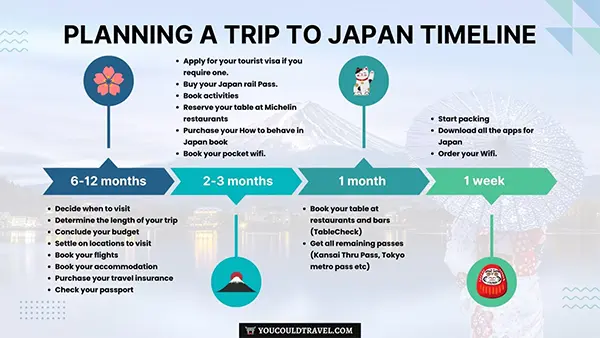
Apart from exploring exotic destinations, let me tell you how you can create the right timelines with the help of the infographic below:
How to Plan a Smooth Solo Travel Itinerary
The secret to a successful solo itinerary in Japan is slow travel. Trying to hit Tokyo, Kyoto, Osaka, Hiroshima, and Hokkaido in ten days will leave a person exhausted and broke from transit costs.
Before you arrive, set up an eSIM for Japan so you can access maps, train schedules, and other services from the moment you land.
This time, flip the script by picking two bases.
- Spend five days deeply embedding yourself in Tokyo’s distinct neighborhoods–from the vintage clothing alleys of Shimokitazawa to the neon alleys of Akihabara.
- Take a single journey down to the Kansai region to explore Osaka and Kyoto.
- Give yourself permission to have zero days, afternoons where you do nothing but sit in a vending-machine-lined alleyway park.
Now, just spinning green tea and watching the city move around you!
Final Thoughts
Well, on my exploration journey, I realise solo travel in Japan is like a lesson in mindfulness. It feels more like a place where one can be completely alone without ever feeling lonely.
Wanderers can unlock a version of travel that changes how they view the world. It just requires embracing the rhythm of the local culture, as simple as eating at the counter bars, sleeping in pristine ponds, and walking through midnight streets with absolute peace of mind.
Finally, pack light, leave your expectations at the border, and let Japan unfold before you, one quiet street at a time.
1) What’s the status of English in Japan when traveling alone?
You will find that almost all major businesses and tourist areas have signs in both Japanese and English.
2) What is the recommended amount of cash to carry with you?
If you’re going to restaurants or other places that don’t accept credit cards, you will want to carry about ¥3,000-¥5,000 (20-35 USD) in cash each day for street food, temple admission, and older vending machines.
3) Are capsule hotels safe for women traveling alone?
Yes, you are perfectly safe in capsule hotels! There will be males and females, and the hotels have separate floors and men’s and women’s locker rooms and elevators, and entry is through secure keycards.
4) I am lost in a huge train station like Shinjuku. What should I do?
First, do not panic! You can find the exits from the station by looking for the bright yellow signs above your head that show where the streets are. If you are completely turned around you can also show your phone’s map to any of the ticket gate staff, and they will be happy to assist you to find your way out of the station.