“It is not the mountain we conquer, but ourselves.”
– Sir Edmund Hillary (Mountaineer, Explorer and Philanthropist)
Imagine a world where the skyscrapers are made of ice, and traffic jams do not consist of vehicles but furry yaks, and the air feels fresh and cool like drinking cold water. The trek to the world’s highest peak is on the bucket list of almost everyone. It is a journey that takes you away from the noise of modern life.
The Everest base camp trekking experience is not just a trekking experience; it is a masterclass of endurance and Himalayan water.
Overview of the Everest Base Camp Trek
The journey to the foot of Sagarmatha, which is the Nepali name for Everest, is a pilgrimage through the heart of Sherpa culture. The hike is not just through the rock and ice, but the ancient villages, listening to the rhythmic bells of yak caravans.
For the restless souls who find the main trail too crowded, the Gokyo Lake Trek offers a stunning view and experience, and presents the view of the Everest region from a completely different perspective.
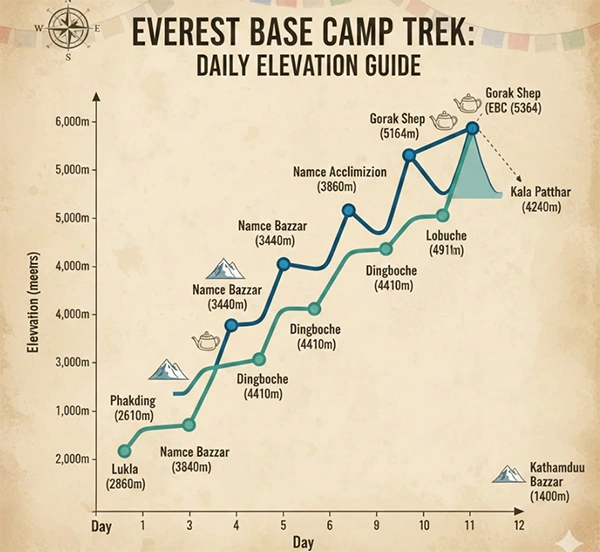
Day 1: Fly to Lukla and Trek to Phakding (2,610 m)
- The Adrenaline Kick: Your journey begins at the Tenzing-Hillary Airport, which is among the most dangerous airports.
- The Descent: Once your heartbeat is settled, you will take a walk to Phakding, which is a gentle 3-hour stroll past Mani stones.
Day 2: Phakding to Namche Bazaar (3,440 m)
- The Challenging Bridge: The Hillary Suspension Bridge is a dizzying span that you have to cross with prayer flags hanging above the river.
- The Uphill Slog: The final hours will be brutal; it will be your very first test, where you have to keep your pace slow and steady like a Sherpa to reach the vibrant Namche Bazaar.
Day 3: Acclimatization Day in Namche Bazaar
Do not stay in bed on the third day, and hike up to the Everest View Hotel, which will be your first ‘Hi, Everest!’ moment, where you will see Everest, Ama Dablam, and Lhotse.
Day 4: Namche Bazaar to Tengboche (3,860 m)
- The Spiritual Heart and Ritual: The trail is undoubtedly the most beautiful one, which will take you to the Tengboche Monastery through the forest. If you’re lucky and arrive by afternoon, you can witness monks chanting and the sound of horns.
Day 5: Tengboche to Dingboche (4,410 m)
On the fifth day, you’ll be entering the Alpine Zone, and Ama Dablam will loom over you all day. You will begin to feel the air thin as you reach the high-altitude and windy village, Dingboche.
Day 6: Acclimatization Day in Dingboche
Here, most trekkers climb Nnagkartshang Peak on the sixth day. From the top, you will be able to see the world’s fourth, fifth, and sixth largest peaks. Even though the climb is hectic, it will prepare your lungs for the 5,000m+ mark.
Day 7: Dingboche to Lobuche (4,910 m)
You will encounter a graveyard of stone monuments at the Thukla Pass. It is a place that demands respect as it is dedicated to fallen climbers. Your day will end alongside the Khumbu Glacier moraine.
Fun Fact: The Khumbu Glacier moves 3-4 feet every day!
Day 8: Lobuche to Gorak Shep (5,164 m) and Everest Base Camp (5,364 m)
This will be a long day, where you’ll reach the tiny settlement of Gorak Shep. At the Khumbu Glacier, you will be surrounded by yellow tents and prayer flags, which will give you an electrifying feeling.
Day 9: Hike to Kala Patthar (5,545 m) and Descend to Pheriche (4,240 m)
- The Summit: The ninth-day trek will begin early in the morning, even though it will be cold, you’ll forget it when the sun hits the summit of Everrest from the top of Kala Pathar. Coming down, you will feel recharged and breathing again.
Day 10: Pheriche to Namche Bazaar
You’ll be able to cover the ground in hours and back in Namche, treat yourself to a hot shower and a good meal.
Did You Know?
There are ‘High Altitude’ ATMs in Namche Bazaar; however, there is no confirmation whether you’ll find cash there, so don’t forget to bring cash.
Day 11: Namche Bazaar to Lukla
The walk from Namche Bazaar to Lukla will be a long one with flat walking, where you’ll pass through the same villages, but this time, you won’t be the same person when you started the journey.
Day 12: Fly Back to Kathmandu
Take one last look at the peaks from the window of the plane, you may find the chaos of Kathmandu city weird after spending time in the silence of the mountains.
Acclimatization and Altitude Awareness
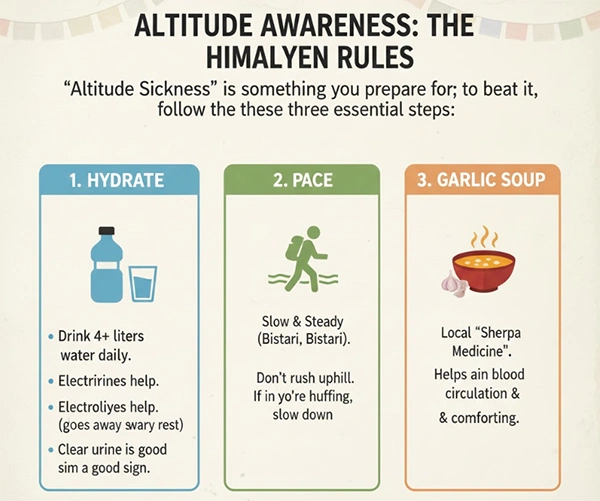
‘Altitude Sickness’ is something that you may have little control over; to beat it, you need to have three things:
- Stay hydrated and drink as much water as you can.
- Keep your pace slow and steady; if you are huffing, you are not following the right pace.
- Garlic soup is the local ‘Sherpa medicine’, which is not only delicious but will also help you with blood flow.
Trek Difficulty and Preparation
The trek doesn’t ask for a lot of technical climbing; it requires ‘Grit’. You must prepare your legs with lunges and step-ups. As for lungs, High-Intensity Interval Training (HIIT) is your option. You also need to prepare your mind for cold nights, no Wi-Fi, and basic toilets.
Best Time to Trek
- During Spring (March to May): It is best for climbing expeditions and looking at wildflowers.
- During Autumn (September to November): If you want to look at a crystal clear view and stable weather, these months will be best for you.
Alternative Routes and Extensions
If Everest Base Camp (EBC) feels too mainstream, you can have a look at the Three Passes Trek. It does include EBC, but it also adds three 5,000+ passes that are less crowded but more challenging.
Conclusion: The Journey of a Lifetime
This trek is not just about standing at the bottom of a big rock, but it is more about your endurance and willpower. The trek to Everest will change you, and you return home with a quieter mind and knowledge that you can endure much more than you thought.
Ques: Is a guide necessary for EBC?
Ans: If you are an experienced trekker, you can go solo; however, a guide can provide you with invaluable cultural insight, logistical ease, and safety monitoring.
Ques: How much will the Trek cost?
Ans: The cost of the trek will depend on the level of comfort you wish for. You can expect the cost to be around $1,200 $2,500 USD, which includes flights and permits.
Ques: Is Wi-Fi available on the trail?
Ans: Yes, you can get ‘Everest Link’ cards at most of the teahouses; however, the connection might get weaker as you go higher.