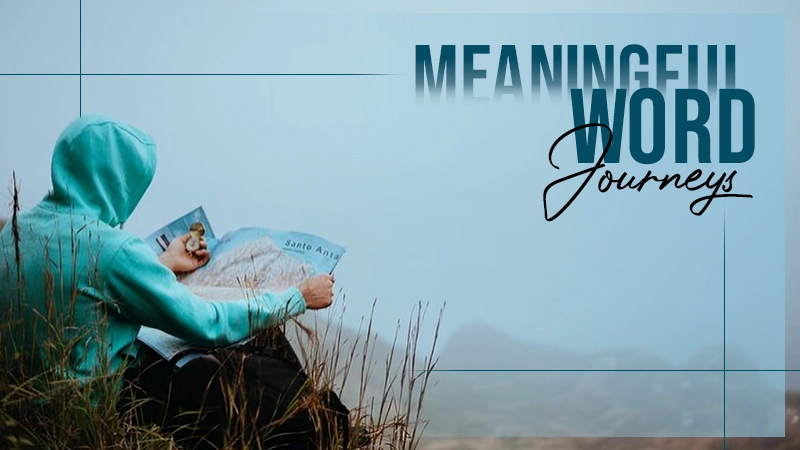
What if the key to understanding your travel experiences wasn’t in your passport photos – but in the words that you haven’t even heard to describe them?
Scientists have now claimed that the language that you speak doesn’t just help you to communicate – but it highly influences how you experience and feel the world around you, from emotions to retaining memories. (Source – Verywell Mind)
And people indeed use special words across the globe – sometimes hundreds of years old – to describe unusual feelings and experiences.
In this culture and travel guide, you will explore unique travel words from around the world – and why language matters when it comes to describing exceptional feelings.
Why Travel Words Add Meaning to Our Journeys
Imagine wanting to describe that unnameable feeling that you get when your plane begins to land in your favourite foreign city – the thrill, the nervousness and that deep sense of “something new and exciting”. But there is not even a single English word that can sum this up, but many other cultures have one – because language isn’t just communication, it’s a bag full of feelings and experiences.
Such words help us flawlessly share our real feelings nd stories about our travel. They are like the emotional shortcuts – feelings wanting to be unpacked in conversations and writings.
Surprising Fact
Researchers shared that when a word doesn’t exist in English, it often reflects how other cultures notice and value emotions – especially feelings related to longing, joy and travel – English has overlooked them.
Inspiring Travel Words From Around the World
Travel often provides experiences that are hard to explain but are instantly familiar. Long before guide books were there, cultures around the world found ways to name those moments.
Let’s have a look at those words that capture travel emotions that you have likely felt – even when you never knew what it was called.
Fernweh (German)
A deep and almost melancholic feeling for places that are far away from you and you haven’t seen them yet. It literally means ‘far-sickness’ and is the opposite of home sickness. Germans often use to describe a craving to visit a far away place.
Solivagant (Latin)
A “solo wanderer” – someone who travels alone, not for any constraint but for the joy of solo discovery. It creates a romantic image of a lone traveler discovering unfamiliar places.
Wanderlust (German)
One of the most familiar words in the travel world, wanderlust originally referred to a passion for wandering. It was related to German Romanticism before making its own way into English.
Resfeber (Swedish)
That restless adrenaline rush just before the start of your journey – has equal parts of excitement and anxiety.
Eleutheromania (Greek)
A strong desire for freedom – either it is related to tiny mountain towns or empty roads at sunrise.
Vagabonding (English)
It is above travelling – a lifestyle philosophy of long term and low budget travelling. It includes embracing every predictable or unpredictable experience.
Dérive (French)

A spontaneous journey that allows the place to guide your way – and not the itinerary.
Sehnsucht (German)
A deep, sad longing not only for travel but for a type of life that attracts dreamers to come towards it.
Itinerant (English)
It means moving from one place to another very often – useful for describing the nomadic patterns of life.
Hiraeth (Welsh)
A homesickness with a little feeling of grief and nostalgia – not just for a place, but for a time and feeling that is not easily reachable.
Saudade (Portuguese)
A deep bittersweet longing for something not present at the moment but cherished – could be a place, person or a moment. It appears in Portugal’s literature, music and daily speech.
Yūgen (Japanese)
A poetic sense of the mysterious beauty of the world – a deep feeling that you get while standing beneath a starry sky.
Kōyō (Japanese)
It directs to autumn leaves, it expresses the appreciation of natural beauty and change – a seasonal travel emotion recognized by almost every other traveler.
Meraki (Greek)

Performing something wth love and soul – a mindset travellers often get when immersing in slow experiences.
Ubuntu (Nguni languages)
Often shared as “I am because we are”, expressing the shared humanity – something travellers often rediscover when crossing cultural boundaries.
Flâneur (French)
A stress free urban wanderer who looks at the view of life from cafes and boulevards – a city explorer of attitude rather than agenda.
Sisu (Finnish)
A blend of resilience and spirited determination that helps travelers push through tough hikes or log days abroad.
Gigil (Filipino)

An overwhelming urge to pinch or squeeze something cute. In travel terms, the sudden rush of affection you get when you visit a tiny cafe or find a child’s laugh on a metro ride.
Vorfreude (German)
That curious anticipation we feel before a trip – the enjoying suspense of planning that very first morning in a new place.
Mångata (Swedish)
The poetic reflection of the moon’s light on water – a visual travel moment that stays vivid long after the journey ends.
How These Travel Words Shape the Way We Experience the World
These words reside in the hearts of the travellers – as they provide vocabulary for emotions. When you are able to express exactly what you feel – like saudade for a place you miss. Much like the – Local art reflects a culture’s unspoken stories.
These words help us reflect on travel not just as a series of destinations we travelled, but as an inner trip of personal experiences.
Embracing Cultural Meaning Through Travel Language
The next time you’re on the road, wait and try to listen to how the locals express their feelings about place and movement. Experiences like a ‘China Voyage’, getting familiar with even three to four common words can deepen your learning and reveal the cultural layers that would otherwise be missed.
‘Language isn’t just communication – it’s a way of looking at the world.’
Conclusion
Travel is not only about where you go – it’s also about how the journey changes you. And, many times, the right word can express that change better than a collage of a thousand photos ever could.
‘Embrace the linguistic gems – and allow them to deepen the meaning of your journey’.
How do the meaningful travel words enhance travel experiences?
They help the travelers to recognize, process and shape by culture, history and lifestyle. And these words are noticed by some societies and named experiences that others didn’t.
Is wanderlust the same as fernweh?
No, wanderlust is a desire to travel, while fernweh is a deeper want for places you haven’t seen yet.
Do these words actually influence how you remember trips?
Yes, when you name emotions, it strengthens your memory. This results in more meaningful travel experiences.