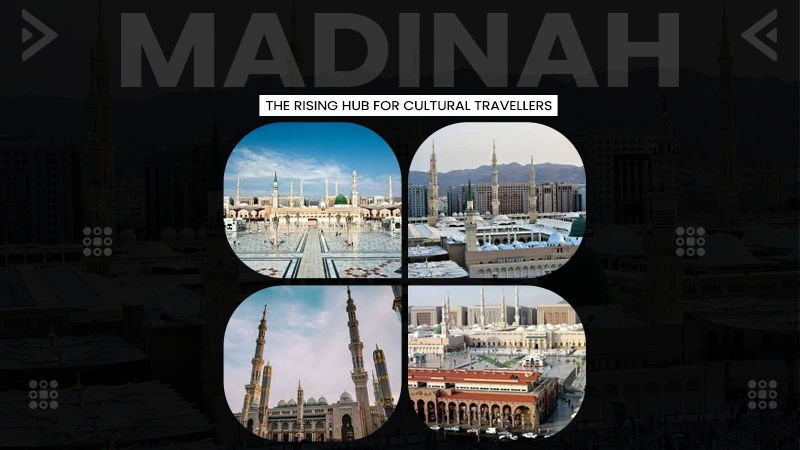
Al-Madinah Al-Monawara, or Madinah to some, is one of the primary cities in the Kingdom of Saudi Arabia. Madinah is located in the west, between the Hijazi and Red Sea, and to the south of its main gateway, which is Mecca. Many Muslim travellers are discovering Madinah as it continues to grow as a tourist destination.
Originally, Madinah was named Yathrib before Muhammad’s (PBUH) migration to Madinah, when it became known as Al-Madinah Al-Monawara or the City of the Prophet (PBUH). While Madinah’s significance is derived from its status as a holy city, it also has significant cultural and architectural heritage.
Umrah travel packages take you to the city of peace and the Prophet (PBUH). This is accurate and reflects the calmness and hospitality of Madinah, which are vastly different from other Saudi cities. Wouldn’t you like to visit Madinah?
KEY TAKEAWAYS
- Madinah is now a full-fledged cultural destination with 3D museums and heritage centers.
- High-speed trains and expanded airports make the city accessible to global travelers.
- The “City of Peace” has an atmosphere that remains uniquely tranquil compared to other major Saudi hubs.
The Heart of Culture: Prophet’s Mosque in Madinah
The Prophet’s Mosque (Masjid an-Nabawi) is the famous Mosque of Madinah because of which the city is known.
The Prophet’s Mosque has a high level of spirituality just like the Grand Mosque of Makkah. And to visit the Rawdah area of the Prophet’s Mosque, you must get an approved permit online from a recognised source only.
More than 250 giant umbrellas installed in the courtyard of the Mosque are the identity of Madinah. These umbrellas protect visitors from the harsh sunlight and light rain. The soul of the Mosque is its green dome, which holds historical and emotional significance for travellers.
This is the sacred tomb of the Prophet Muhammad (PBUH). If we see the cultural aspect of the dome, it has remained in its original form for centuries and shows a blend of Ottoman and Saudi architectures.
The Prophet’s Mosque has a place called “Ashab-e-Suffah” where knowledge was distributed to the world. It could be regarded as the first residential university.
Moreover, the architecture of the Prophet’s Mosque is divided into old and modern expansions. Both are different from each other.
The old expansions have intricate designs and Arabic calligraphy, while the modern part is considered to be most beautiful due to white marble and gold-plated minarets.
Museums and Heritage Centres of Madinah
Under the ‘Vision 2030’ initiative of Saudi Arabia, the city of Madinah will be transformed into an important cultural destination for global tourism with many modern, educational and informative museums and heritage sites.
Going there feels like you have gone back in time. The historical centres of Madinah are perfect for cultural travellers who travel not just for sightseeing or shopping but to learn the cultural norms of other destinations.
Even though places are not just for showing off, but to make tourists feel the history. There are many historical centres in Madinah, and the famous one is the International Museum of the Prophet’s Biography and Islamic Civilisation.
A unique modern Museum about the life of the Prophet Muhammad (PBUH) is located just to the south of the Prophet’s Mosque. Through modern technology, including 3D displays, holograms and virtual reality, you can experience the entire timeframe of the Prophet’s life (PBUH).
There are more than thirty sections that show prophetic life. Additionally, Dar Al-Madinah Heritage Museum is the best place to learn the urban history of Madinah.
Here, pilgrims and cultural travellers can explore rare collections and the architecture of the mosque’s old expansions. A special exhibit (bow) of the famous companion of Prophet Muhammad (PBUH), Sa’ad ibn Abi Waqas (R.A), is also there.
Another example of an ancient railway system from the Ottoman Empire is the Hejaz Railway Museum, located near Al-Anbariyah Station. Al-Anbariyah Station was built in 1908 and was one of the stations that connected the Ottoman Empire to Madinah via an extensive rail line.
Original carriages have now been turned into train restaurants. Moving on, another famous museum is As-Safiyah and Orchard, which is nearer to the Prophet’s Mosque.
This historical centre joins the natural and cultural mixture of Madinah with digital storytelling and palm groves. It evokes the oasis of old Madinah.
Quba Front and Walking Trails
The Quba Front and Walking Trail are among the cultural areas of Madinah. Quba Walking Trail is not just a footpath but a route on which the Prophet Muhammad (PBUH) used to travel every week from the Prophet’s Mosque to the Quba Mosque. That’s why walking on this trail is also known as the Sunnah walk.
The distance is only 3 to 4 kilometres, and you can easily reach the Mosque within 45 to 60 minutes. You won’t see any vehicles on the pedestrianized streets leading to these sites as the roads were built as part of the Humanisation of Cities initiative.
Some travellers also call this trail Quba Front because they leave the Prophet’s Mosque via Bab-e-Salam and follow the trail towards Quba Mosque. The whole trail is family-friendly, where tourists can enjoy shopping kiosks, food at cafes, and festivals during special events.
While walking on trails, you will find famous tourist spots of Madinah, including Al-Jumma neighbourhood, Mosque al-Ghamamah, Mosque Abu Bakr, and Quba Square & fort.
If you’re unable to walk a long distance along the trail, there are also electric golf carts available for hire. The cost of hire is approximately 10 SAR, which makes golf carts a great option for tourists travelling with older family members or young children.
If you want to have the best and most comfortable experience on the trail, then walk after sunset or before sunrise.
Cultural and Festival Events in Madinah
Do not consider Madinah only a place of worship or a religious city because it has become a big centre of cultural festivals. The main purpose of these festivals is to show tourists the history of the city, its lifestyle, and cultural diversity.
One of the famous festivals is Rahaba, which occurs during the whole month of Ramadan, near King Fahd Central Park. Cultural travellers coming with Ramadan Umrah packages enjoy the different vibes like Bukhari rice, Sobia drink, and local sweets of Madinah.
A signature event for Madinah is the International Cultural Festival, organised by the Islamic University of Madinah, which features cultural demonstrations and clothing by students from around the world, representing over 100 different countries.
The primary focus of this festival is to spread peace and break stereotypes. Some events are purely based on the history of Madinah and traditions of Saudi Arabia, such as “Memory of the Land” and “Madinah Art Centre Events”.
During the Time Capsule Festival, visitors can see how life was in Madinah in the past through a recreation of its way of life. Also, if you love art and calligraphy, you will find several creative art centres in Madinah, showcasing visual art and offering workshops in spectacularly designed buildings.
Modern Infrastructure of Madinah
With the modern infrastructure, Madinah has now become a smart city. The changes are taking place under Saudi Vision 2030 that will transform the experience of pilgrims and cultural travellers.
For those who wish to explore the neighbouring cities of Madinah or other regions situated on the Haramain high-speed train route, this sleekly designed bullet train provides hassle-free trips, allowing you to travel from one metropolis to another in minutes.
In addition, Prince Mohammad bin Abdulaziz Airport in Madinah is also expanding. By 2027, its capacity will be increased to 17 to 18 million passengers annually. Furthermore, you can stay during your trip in luxury chain hotels.
Mega urban development is part of the modern infrastructure of the city. Rua Al Madinah Project is one of the ongoing projects aiming to develop new hotel rooms, open spaces, and parks.
Overall, the cultural diversity of Madinah continues to thrive and is enhanced by modern infrastructure. The Islamic Civilization Village is part of a newly developed project and will provide eight new cultural zones demonstrating Islamic culture. Visitors will enjoy exploring the open-air museum in this community, where they can experience Islamic culture and see the historic foundations of the Islamic faith.
The Culture of Dates in Madinah
The culture of dates in Madinah is not just about fruit, but it also reflects the economy, history, and hospitality. When we talk about cultural tourism, date palm farms have now become a big attraction.
It’s a proper Ziyarat point named “Salman Farsi Garden” in Madinah that pilgrims and tourists visit during the pilgrimage. The most special date of Madinah is “Ajwa”, which is also mentioned in the Hadith (the second strongest Islamic source).
That’s why the Ajwa date is very famous all around the world. It’s dark black in colour and sweet in taste with healing properties.
To this extent, every year a big date fair is held in the city where farmers and sellers sell dates and buyers enjoy the culture. Sellers pack the dates in luxury packaging, reflecting the sophistication of Arab culture.
Madinah is a unique destination for travellers of all backgrounds and nationalities. This city fosters a unique sense of tranquillity that can only be felt through compound sounds of space. The vision of Madinah is to maintain its rich cultural heritage whilst moving forward with modernity.
Additionally, Madinah exemplifies how the past can be celebrated while ensuring prosperity by incorporating both the grandeur of the long-standing historic structure as well as the ambition of a forward-thinking future that counts on people-power.
The future of Madinah relies heavily on the success of Saudi Vision 2030. Consideration should now be given to taking advantage of Madinah as a destination rather than just Makkah or other cities in Saudi Arabia. Reserve your tickets ahead of time and set out on your trip to Madinah!
Can a person who isn’t a Muslim visit Madina?
Yes, the city is open to all people. However, you must be a Muslim to enter the Holy Prophets Masjid.
Where do I get my permit for Rawdah?
You can get your Rawdah permit through the Nusuk website or mobile app/IELTS test.
When is the best time to walk the Quba Trail?
To escape the heat and sun, plan your walk between dawn and dusk.
Is there a dress code?
Yes, both men and women should be dressed conservatively while visiting religious sites. Women should wear an Abaya at these locations.