
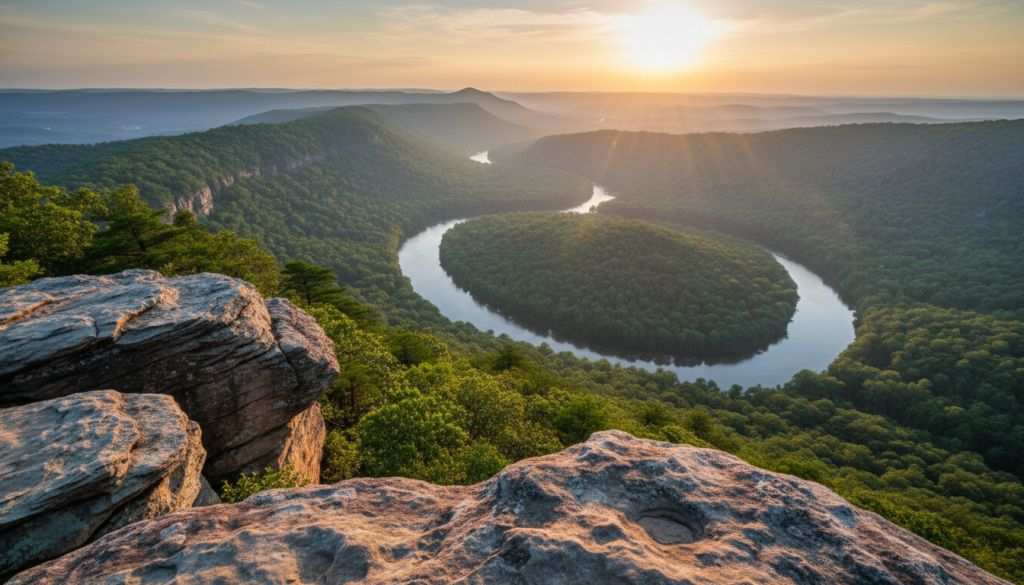
Lookout Mountain rises at the intersection of Tennessee, Georgia, and Alabama, a geographic distinction that alone makes it unusual. But the real surprises lie beneath its surface, inside its rock formations, and along trails that most visitors never find. For travelers drawn to Lookout Mountain rentals as a base camp for exploration, this ridgeline delivers far more than the famous view from Point Park.
A Waterfall Inside a Mountain
Ruby Falls, a 145-foot underground waterfall located 1,120 feet beneath the surface of Lookout Mountain, is one of the deepest commercially accessible caves in the United States. The journey to the falls involves an elevator descent followed by a winding walk through limestone passages decorated with stalactites, stalagmites, and flowstone formations shaped over millions of years. The waterfall itself plunges into an underground pool in a cavern illuminated by carefully positioned lights that reveal the scale of the space. What makes Ruby Falls genuinely remarkable is that it was discovered entirely by accident in 1928, when explorers drilling a new entrance to a nearby cave broke through into an unknown passage system.
Rock City and the Barn Painting Tradition
Rock City Gardens occupies a natural rock outcropping near the mountain’s summit, where massive sandstone formations create narrow passages, natural bridges, and a network of walkways through ancient boulders draped in native plants and mosses. The Lover’s Leap overlook claims visibility across seven states on clear days, a boast that has been debated and defended for decades. But Rock City’s most curious legacy may be its marketing: beginning in the 1930s, barn owners across the rural South were paid as little as three dollars to let a traveling sign painter emblazon “See Rock City” on their rooftops. Hundreds of these barns survive today, creating one of the most distinctive and enduring advertising campaigns in American history.
Civil War Echoes on the Ridge
Lookout Mountain’s strategic position above the Tennessee River made it a critical objective during the Civil War. The Battle of Lookout Mountain, fought in November 1863, became known as the “Battle Above the Clouds” due to the fog that obscured much of the fighting from observers below. Point Park, maintained by the National Park Service, preserves the battlefield and offers interpretive exhibits that trace the movements of Union and Confederate forces across the mountain’s slopes. Walking the grounds today, you can still see the earthworks and rifle pits that soldiers carved into the rocky terrain, now softened by more than 160 years of forest growth.
Trails Beyond the Tourist Stops
The mountain’s less commercialized trails reveal a quieter side. The Bluff Trail follows the western escarpment through mixed hardwood forest, with periodic openings that frame views of the Tennessee Valley far below.
Covenant College’s campus, perched near the mountain’s southern end, is open to respectful visitors and features walking paths through mature stands of oak and hickory. For a longer outing, the Guild Trail descends from the mountain into Reflection Riding Arboretum and Nature Center, a 300-acre preserve with native plant collections, a raptor rehabilitation center, and access to the Chattanooga Creek watershed.
Greater Chattanooga as a Home Base
Lookout Mountain is just one piece of the greater Chattanooga outdoor puzzle. The city itself has invested heavily in trail infrastructure, public riverfront access, and climbing areas along the Tennessee River gorge. Signal Mountain and Raccoon Mountain offer additional hiking and hang-gliding opportunities, while the Tennessee Aquarium and Coolidge Park anchor the downtown waterfront. Exploring more rentals in Greater Chattanooga opens access to this entire network without the limitations of a single hotel location.
When to Visit
Spring wildflower season and autumn foliage are the peak periods, but winter offers its own advantages: thinner crowds, clearer air for long-distance views, and the atmospheric experience of watching fog settle into the valley below while you stand above it in sunshine. Any season on Lookout Mountain rewards visitors willing to look beyond the marquee attractions.