- Why Traditional Tourist Routes Keep Failing Travelers
- Offbeat Destinations: The Geography of the Overlooked
- Cultural Immersion: What It Actually Takes
- Staying Connected Without Losing the Experience
- Meaningful Travel and the Question of Impact
- Sustainable Tourism: What Local Communities Actually Want
- How to Start: Practical First Steps
- Conclusion
Speed kills curiosity. That’s the quiet truth most frequent travellers eventually realise — often after their fifth rushed city in eight days, blurry photos and zero memories of actual conversations. This is the opposite of slow adventure travel. It’s a deliberate decision to walk less, linger longer, pay attention.
It isn’t just about pace, though. It’s a mindset. Slow tourism means choosing depth over breadth, meaning over mileage.
Read further to explore more!
Key Takeaways
- Slow adventure travel is about genuine experiences rather than rushing from one place to another.
- Longer visits give travellers the chance to develop richer ties with a place’s culture and its people.
- Off-the-beaten-path destinations often offer more genuine and less crowded experiences.
- Slow travel is often good for local businesses, and it has a more positive economic impact on communities.
Why Traditional Tourist Routes Keep Failing Travelers
The world’s most visited attractions attracted 1.4 billion international tourists in 2023, according to the UNWTO. Yet surveys consistently show that more than half of travelers feel their trips didn’t meet expectations. That gap is revealing.
Traditional tourist routes are optimized for volume, not experience. Buses arrive, photos get taken, buses leave. The local economy is often helped less than you’d think — a 2019 report from the Centre for Responsible Travel estimated that in some package tourism destinations, up to 80% of tourist spending never reaches local communities.
Slow travel flips that equation. When you stay in one place for a week instead of a night, you eat where locals eat, you spend money at neighbourhood shops, and you start to matter — just slightly — to the place you’re visiting.
Offbeat Destinations: The Geography of the Overlooked
There’s a rule of the same thirty cities for travel content. They’re easy. Infrastructure is built for visitors. But that infrastructure is what separates you also from anything real.
Consider these alternatives most travelers walk past:
- Fagaras Mountains, Romania — dramatic hiking, medieval villages, almost no English-language tourism infrastructure
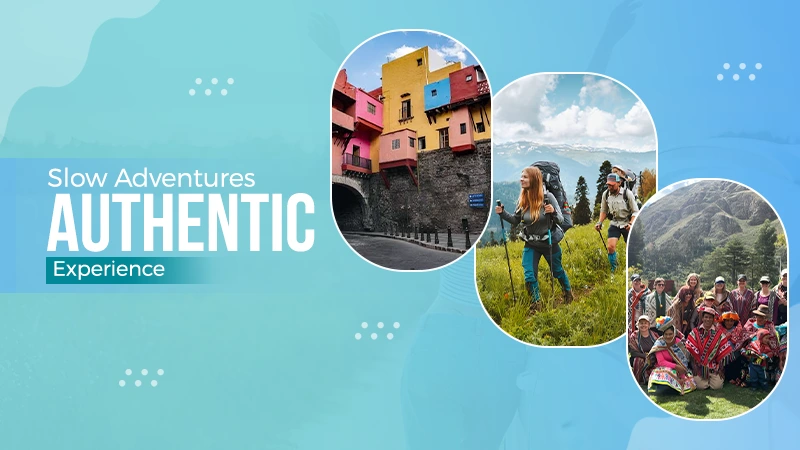
- Guanajuato, Mexico — a UNESCO city with actual residents still living in it, not yet hollowed out by short-term rentals
- Goris, Armenia — ancient cave dwellings, zero crowds, extraordinary food
- Istria’s interior villages, Croatia — truffle country, empty roads, stone-house stays arranged through locals on Facebook groups
None of theseneed special skills or unusual budgets. They require patience and a willingness to figure things out without a pamphlet.
Cultural Immersion: What It Actually Takes
“Travel is fatal to prejudice, bigotry, and narrow-mindedness.” — Mark Twain
The quote gets shared a lot. Theconditions it demands get talked about much less. Cultural immersion isn’t automatic. You don’t absorb a place by walking through it fast.
Real immersion takes a few specific things. Time is the obvious one. But it also takes discomfort — the willingness to notask a bad question to understand something, to eat something you can’t identify. It takes showing up to the same café three mornings in a row until the owner stops treating you like a tourist. It takes learning six words in the local language and using all of them badly.
When those conditions are met, something shifts. The place stops being a backdrop and starts being a relationship.
Staying Connected Without Losing the Experience
Slow travel does not mean going off-line. Most independents, in practice,travelers depend on digital tools — to navigate, to research, to stay in touch with family, to book the next guesthouse two days before arrival instead of three months out. That flexibility is part of what makes slow travel possible.
When you’re moving when you are in unfamiliar places, public Wi-Fi is unreliableand sometimes genuinely risky. Rural guesthouses, shared workspaces in small towns, cafés in areas with minimal tech infrastructure — these are places where using a secure connection for daily use makes practical sense. Not as a luxury, but as basic digital hygiene when your banking app, email, and your travel documents are stored on the device you are using on an open network in a guesthouse common room.
The point isn’t to turn your trip into a remote-work setup. It’s to handle the logistics cleanly so the rest of the time can actually be present.
Meaningful Travel and the Question of Impact
Here’s an uncomfortable number: tourism represents about 8% of world carbon emissions, according to a 2018 study published in Nature Climate Change. That figure hasn’t improved significantly since.
Slow travel doesn’t solve that entirely. But it changes the maths in significant ways.Fewer flights. Longer stays. Ground transport. Local food systems. The carbon footprint of a three-week stay in one region is dramatically lower than three separate week-long trips to different continents.
Beyond carbon, there’s the question of economic impact. Slow travellers tend to produce what economists call “leakage-resistant” spending — money that circulates within local economies rather than flowing back to international hotel chains or foreign-owned tour operators.
Sustainable Tourism: What Local Communities Actually Want
This part is worth asking directly, and travelers rarely do.
Local communities in popular destinations have complex relationships with tourism. Some welcome it. Many tolerate it. More and more are fighting back.— Barcelona, Amsterdam, and Kyoto have all introduced visitor caps or anti-tourism measures in recent years.
What communities consistently say they prefer:
- Visitors who stay longer and spend more locally
- Travelers who learn something about the place before arriving
- People who respect seasonal rhythms — not arriving during harvest, not hiking during breeding season
- Guests who ask before photographing, and accept no for an answer
Slow travelers, almost by definition, tend to meet more of these criteria. Not perfectly. But more.
How to Start: Practical First Steps
The shift doesn’t have to be total. You don’t have to leave your job and travel for a year to practice slow tourism.
A few starting points that work:
- Pick one place instead of three for your next trip. Spend the same amount of time in fewer locations.
- Book accommodation with locals through guesthouses, family-run hostels, or home-stay platforms that direct income to residents.
- Arrive without a full itinerary. Leave at least 40% of your days unplanned and see what the place offers.
- Use surface transport at least once per trip — a train, a ferry, a bus. The journey itself is often the experience.
Slow at its core, adventure travel is a bet that the world is more interesting than the highlight reel suggests. The evidence, for those who’ve tried it, tends to support that bet.
Conclusion
Slow adventure travel is about experiencing things that count, not rushing from one attraction to the next.
It allows tourists to experience the local culture, communities and natural surroundings at a more relaxed pace, rather rather than following the traditional tourist path.
Exploration takes time, and as a result, you gain a deeper understanding, more meaningful memories, and authentic experiences. In this way, the journey becomes just as important as the destination.
What are the benefits of slow travel?
Slow travel encourages tourists to take their time and truly experience the places they visit.
When did slow travel become popular?
The slow travel movement dates back to the 1980s, specifically 1986, when the slow food movement emerged.
How to have authentic travel experiences?
Avoid tourist traps, eat at the favourite small local restaurant, attend festivals for local holidays, and support local businesses.
What is the slowest time to travel?
On the flip side, the quietest time to travel comes right after the holidays. From mid-January through early February: Passenger counts often drop below 2 million. Late January sees the lowest numbers of the year.