St. Michaels sits on a slender peninsula jutting into the Miles River on Maryland’s Eastern Shore, and it has been quietly accumulating peculiar stories for over three centuries. This is a town that once tricked the British Navy with lanterns, built a maritime museum around a working lighthouse, and still operates a ferry that essentially exists because locals refused to drive the long way around. For anyone seeking a St. Michaels rental as a base for exploration, the quirks here run deep.
The Town That Fooled the British
During the War of 1812, British ships sailed up the Miles River intent on shelling St. Michaels. According to local legend, residents dimmed their house lights and hung lanterns high in the treetops and on ship masts. The British aimed at the lights, sending their cannonballs sailing over the rooftops and into the surrounding fields. Only one house reportedly took a direct hit, and it still stands on Mulberry Street, known today as the “Cannonball House.” Historians debate the story’s finer details, but the town has proudly claimed the nickname “The Town That Fooled the British” for over two hundred years.
A Lighthouse You Can Actually Visit
The Chesapeake Bay Maritime Museum sprawls across 18 acres at Navy Point, and its centerpiece is the Hooper Strait Lighthouse, a hexagonal cottage-style beacon that was relocated here from its original post in the bay. Unlike most lighthouses that you can only admire from a distance, this one welcomes visitors inside, where the cramped quarters and manual fog bell reveal just how isolated lighthouse keepers were. The museum’s boatyard is equally fascinating: craftspeople restore historic wooden vessels using traditional methods, and you can watch the work in progress any day the museum is open.
Oyster Culture, Past and Present
The Chesapeake Bay’s oyster industry shaped St. Michaels in ways that are still visible. Skipjacks, the traditional oyster dredging sailboats, are among the last commercial sailing vessels in North America, and a few still operate out of nearby Tilghman Island. In town, oyster bars serve the bivalves raw, roasted, and fried, often sourced from farms just a few miles away in the river. The annual OysterFest draws crowds each fall, but visiting outside the festival window means shorter lines and more relaxed conversations with the shuckers.
Cycling the Flat, Scenic Back Roads
The Eastern Shore’s pancake-flat terrain makes it ideal for cycling, and the roads around St. Michaels wind past cornfields, crab shacks, and waterfront estates with minimal traffic. A popular loop follows Route 33 toward Tilghman Island, where the road narrows to a single lane crossing the Knapps Narrows drawbridge. The bridge opens regularly for fishing boats, so expect a pleasant pause with views of the working harbor. Bring a lock and stop in Oxford, accessible by the Oxford-Bellevue Ferry, one of the oldest privately operated ferries in the country.
After the Exploring
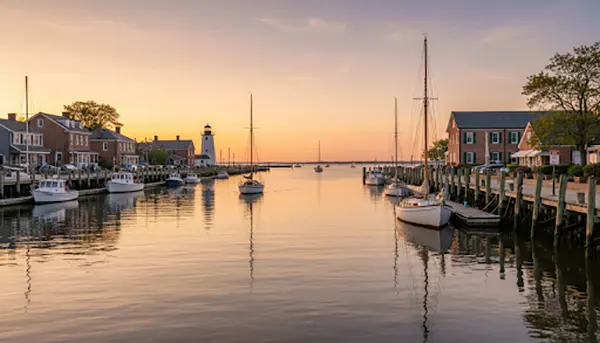
St. Michaels rewards slow evenings. The harbor fills with golden light as the sun drops, and the town’s handful of restaurants serve Chesapeake specialties without the resort-town markup you might expect. A waterfront property with a dock, pool, and space for a group turns a day trip into the kind of extended stay where mornings start with coffee on the porch and afternoons dissolve into kayak rides or crab pot checks.
Getting There
St. Michaels is about 90 minutes from Washington, D.C., and Baltimore, making it reachable for a long weekend. The drive across the Chesapeake Bay Bridge is scenic on its own, and once you reach the Eastern Shore, the pace slows immediately. There are no highways here, just two-lane roads lined with farm stands and hand-painted signs pointing toward the water.