I moved to a new country three years ago for what was supposed to be a one-year contract. The contract did end, but I didn’t leave. Somewhere in the process of settling into a new city, learning a different language, and rebuilding a social life from scratch, travel stopped being a hobby and became a part of my life.
Weekend trips to different destinations, longer breaks back home, and o spontaneous flights, ignoring budgets. But after a year of this, I realized that I had no real sense of how much ground I had covered.
This realization made me start taking tracking seriously, and the format I considered ended up teaching me more about my own habits than I expected.
Key Takeaways
- When you live somewhere new and budget flights to other countries are just a few hours away, travel starts to become frequent, and individual trips start blurring together
- The more travel becomes blended within a lifestyle, the more deliberate effort is required to keep experiences distinct in memory
- With the map as a reference, selecting the next trip became a question of filling a visible gap rather than circling back to whatever was cheapest or most familiar that month
- Forever Map’s level of detail meant the map stayed legible and genuinely informative, even with a dense cluster of pins in one part of the world
Why Expat Life Changes How You Travel
Living abroad changes travel in a specific way that is easy to underestimate before it happens. When travel means going back home for a week once a year, every trip starts to feel significant and is remembered better.
When you live somewhere new and budget flights to other countries are just a few hours away, travel starts to become frequent, and individual trips start blurring together.
A long weekend in one country starts feeling similar to a long weekend in another, and six months later, it becomes genuinely difficult to recall which trip happened when, or in some cases, whether a particular trip happened at all.
This is a documented pattern, not just a personal one. Research into memory and routine has shown that multiple, similar experiences become harder to recall individually than rare, distinct ones, a phenomenon that’s called the boring trip effect among many researchers who study travel psychology.
The more travel becomes blended within a lifestyle, the more deliberate effort is required to keep experiences distinct in memory.
What Changed Once I Started Marking It Down
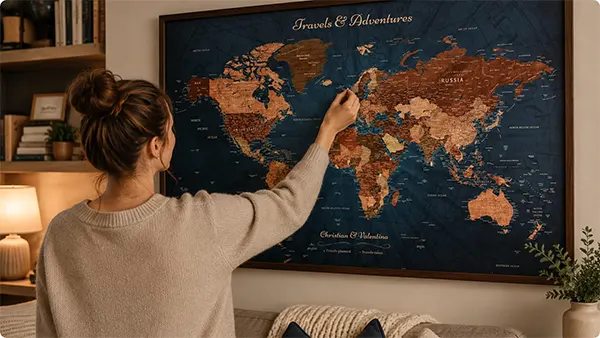
Putting every trip on a physical map turned out to be the most effective fix I found for that blurring effect. The first time I sat down and tried to place a pin for every country I had visited since moving abroad, I genuinely struggled to remember a few of them in the right order, which was itself a useful wake-up call about how much I had been letting slip past unnoticed.
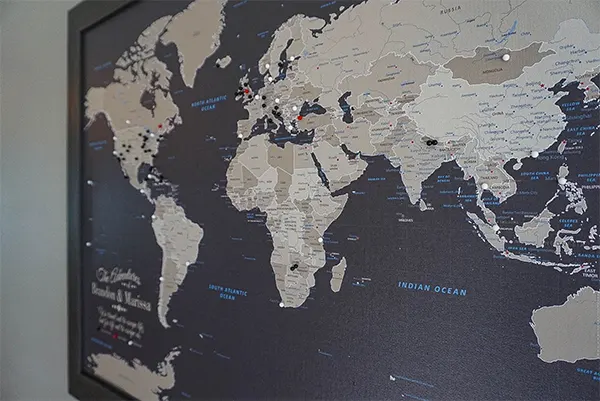
Once the map was filled in, the patterns became immediately visible in a way that no amount of scrolling through photos had revealed. I had visited the same handful of nearby countries repeatedly, treating them as easy weekend defaults, while several countries within a similarly short flight had never come up at all. Seeing that imbalance laid out geographically was far more motivating than any vague sense that I should “explore more” had ever been.
It also changed how I planned. With the map as a reference, selecting the next trip became a question of filling a visible gap rather than circling back to whatever was cheapest or most familiar that month.
The push pin map sitting in my hallway became a genuine planning tool, not just a record of where I had already been.
The Specific Value for Anyone Living Abroad
For anyone in a similar situation, relocated for work, study, or simply by choice, a map-based travel record solves a problem that is somewhat unique to expat life. Travel volume is high enough that individual trips fade quickly, but the geographic spread tends to be uneven in ways that are invisible without a visual reference. A map makes both of those issues visible at once: the volume becomes apparent through the density of pins, and the unevenness becomes apparent through their distribution.
It also serves a secondary function that surprised me. Friends and family back home, who often have a vague sense that “I travel a lot now” without any specific picture of what that means, find the map far more legible than a verbal summary ever could be. Showing someone a map covered in pins communicates more in ten seconds than five minutes of trying to recap trips from memory.
What I Have Settled on for Mine
After some trial and error with formats, I ended up using a system with two pin colors: one for countries visited since moving abroad, and a second for places visited before the move that still feel relevant to the larger picture of where I have been in my life. That second category was something I had not planned for initially, but it ended up mattering more than expected. It turns the map into a fuller personal history rather than just a record of this specific chapter.
The push pin maps made by Forever Map worked well for this particular use case because the geographic detail held up at a scale that mattered to me. A lot of the regional travel that defines life as an expat happens between countries that are small or closely clustered, and a map without enough resolution in those areas loses a lot of its usefulness. Forever Map’s level of detail meant the map stayed legible and genuinely informative even with a dense cluster of pins in one part of the world, which is exactly the situation most people relocating internationally are likely to end up in.
Pro Tip
Instead of just a standard map, you can personalize the canvas with custom text, family names, travel quotes, or even a personalized map legend.
The Takeaway
Three years into living abroad, the map on my wall has become one of the more accurate records of this period of my life, more accurate in some ways than my own memory of it. Frequent travel has a way of flattening into a vague sense of having “gone places” without much specific recall, and a physical, visual record is one of the more effective ways to counteract that. For anyone living a similarly mobile life, putting it down somewhere visible is worth doing sooner rather than waiting until the details have already started to blur.
How does a pushpin map help with travel?
A piushpin map lets you track the places you have visited and the destinations that are still waiting to be explored.
How do I track visited and unvisited places?
It’s best to use a system with two-pin colors, with each color indicating visited and unvisited places. This lets you track better and understand things quickly.
How does it help friends and family?
It helps them to get a better sense of where you travel and how frequently you visit new places.
Why do many experiences start feeling familiar?
When you perform a thing many times, and all the experiences remain somewhat similar to each other, they tend to lose their individuality, thereby making it difficult to remember specific instances.