- The Classic Route: Luxor to Aswan
- Option 1: The Nile Cruise Ship
- Option 2: The Dahabiya
- Option 3: The Felucca
- Quick Comparison
- Choosing the Right Time
- Questions to Ask Before You Book
- Lake Nasser: The Southern Alternative
- Combining Options on One Trip
- What to Pack for a Nile Journey
- Mobility and Accessibility
- Final Thoughts
Egypt has much to explore but is actually hard to explore. As a solution, travelling along the Nile serves as a great way to experience a hidden side of Egypt. Rather than moving between temples and roads by vehicle, you get to see the river, villages and desert landscapes along the way.
The same routine involves various Egypt Nile River cruise packages, while dahabiya provides a simpler and more dedicated experience.
Keep reading to learn how to choose the right way to travel the Nile.
The Classic Route: Luxor to Aswan
Almost every Nile journey goes along the roughly 200-kilometer route between Luxor and Aswan, in one direction or the other. Along the way are plenty of temples that are much easier to obtain from the water than by road, considering Esna, Edfu and Kom Ombo. Some longer journeys advance north of Luxor toward Dendera and Abydos, and a disparate group of boats sails on Lake Nasser, south of the Aswan High Dam, toward Abu Simbel. Egypt Holiday Makers can help travelers set up a Nile journey that fits their ideal route and itinerary.
Which direction you sail makes less distinction than many people expect. Trips that commence in Luxor are often a night longer, while trips that commence in Aswan are slightly more compact and ascend with the current.
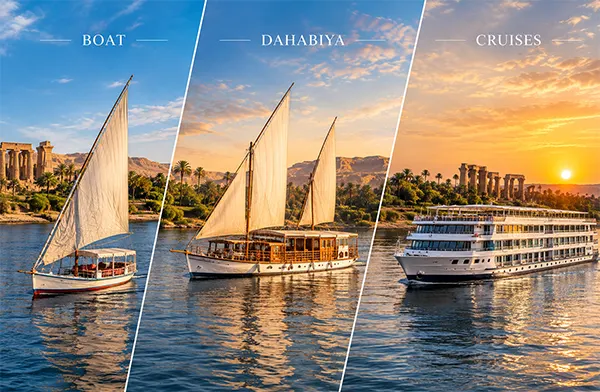
Option 1: The Nile Cruise Ship
Standard Nile cruise ships are floating hotels, commonly with four or five decks, a restaurant, a lounge, a sun deck and a relatively tiny pool. They typically carry anywhere from several dozen to well over a hundred passengers, and they adhere to a fairly fixed program of instructor visits.
What a Typical Day Looks Like
Days usually start early with a scheduled visit to a temple, gone by lunch on board while the ship sails. Afternoons are for lazy days on deck, with a second visit or an evening spectacle such as a themed dinner. At busy stops, cruise ships often moor at least two abreast, so you may walk through the lobbies of other boats to get to the shore.
Who It Suits
- First-time visitors who want a streamlined, all-in-one experience.
- Families who seek a pool and more room to move around.
- Travelers on a fixed schedule, since cruises usually run on set departure periods.
- Anyone who wants to navigate the main sites efficiently in three to four nights.
Things to Consider
Quality varies broadly between ships, so read recent comments rather than relying on star ratings alone. Check what is included, as guided visits, approach fees and drinks are billed differently from boat to boat. Sites can also feel chaotic when several ships load at the same time.
Option 2: The Dahabiya
A dahabiya is a typical two-masted sailing boat based on the vessels used by nineteenth-century travelers. Modern dahabiyas tend to have somewhere around four and twelve cabins, so the number of arrivals stays small.
What a Typical Day Looks Like
Dahabiyas sail when the wind makes sense and are towed by a small tug when it doesn’t. Because they are less bulky, they can moor at quiet riverbanks and spots where large ships cannot stop. That opens up fewer tourists to sites such as Gebel el-Silsila, an outdated sandstone quarry, and El Kab, with its rock-cut tombs. Meals are often offered on deck, and the pace is slower and more versatile.
Who It Suits
- Couples and small groups who value seclusion and a personal atmosphere.
- Travelers who enjoy the adventure itself as much as the destinations.
- Photographers who want to be on the river at dawn and sunset without disturbances.
Things to Consider
Dahabiya trips typically run four to five nights between Esna and Aswan, so they will take more time than a short cruise. Most boats have no pool, and the smaller layout provides less space for socializing if you enjoy a louder atmosphere. The cost per person is usually greater than on a standard ship.
Option 3: The Felucca
The felucca is the easiest way to be on the Nile: an open wooden sailboat with a simple triangular sail. In Aswan and Luxor, one- or two-hour felucca tours are easy to schedule and are among the most peaceful getaways in Egypt, especially around sunset.
For more experienced travelers, multi-day felucca trips drift north from Aswan toward Kom Ombo or Edfu. Passengers can rest on deck under blankets or a canopy, meals are delivered by the crew, and toilet services are basic or on shore.
Who It Suits
- Backpackers and financial travelers.
- Travelers are searching for a simple, close-to-the-water experience.
- Anyone who wants a short, relaxing break between busy days of sightseeing.
Things to Consider
Multi-day felucca trips are basic in contrast with the other options. Nights can be cold in winter, progress depends entirely on the wind, and leisure is minimal. Check what safety gear is on board, and settle clearly on the route, meals and price before sending off.
Quick Comparison
Remembering all might be a bit confusing. Here is a quick comparison guide to take a decision:
| Option | Group size | Typical length | Pace | Suits |
| Cruise ship | Dozens to 100+ guests | 3–4 nights, Luxor–Aswan | Structured, fixed schedule | First-timers, families |
| Dahabiya | Usually under 25 guests | 4–5 nights, Esna–Aswan | Slow and flexible | Couples, small groups |
| Felucca | A handful of passengers | 1 hour to 3 days | Wind-dependent, simple | Budget and adventure travelers |
Choosing the Right Time
The Nile is most useful from October to April. December and January are the highest-volume months, and boats often fill well until the end of the Christmas and New Year period. In summer, afternoon heat can be fierce, but sailing with a breeze on deck is often more helpful than touring on land. Dahabiyas and feluccas heavily rely on the wind, so calm spells can mean more time under tow or at the harbor.
Also, learn what makes a boutique hotel stay truly special.
Questions to Ask Before You Book
- Which sites are included, and are entrance fees allowed?
- Is a certified Egyptologist guide included for each visit?
- How many cabins or passengers are on this ship?
- Where does the boat moor, and will it be near other ships?
- What is served in meals and drinks?
- What happens if the schedule changes because of water levels or incidents at the Esna lock?
Lake Nasser: The Southern Alternative
South of the Aswan High Dam, some boats sail on Lake Nasser, one of the largest synthetic lakes in the world. These journeys typically run three or four nights between Aswan and Abu Simbel and visit temples that were rebuilt during the 1960s salvage campaign, such as Kalabsha, Amada and Wadi el-Seboua.
The atmosphere is very distant from the main river. The lake is wide and exclusive, with desert shores and few other boats, and the major draw is often arriving at Abu Simbel by water, sometimes with the rare opportunity to see the temples lit in the evening. Lake Nasser cruises cater to travelers who have already seen the main Nile Valley sites or who want a simpler, more remote itinerary.
Combining Options on One Trip
You don’t have to select just one way to travel the river. A popular travel strategy is to take a cruise ship or dahabiya for the crucial Luxor–Aswan section and then arrange a sunset felucca ride in Aswan. Travelers with more time sometimes blend a Nile Valley journey with a Lake Nasser cruise to access Abu Simbel without the long road trip.
What to Pack for a Nile Journey
Having essentials along the trip ensures the trip remains smooth:
- Layers. Mornings and evenings on the river can be breezy in winter, even when afternoons are warm.
- A wide-brimmed hat, sunglasses and high-SPF sunscreen for long hours on deck.
- Comfortable walking shoes for temple visits, which often involve rough ground.
- Modest clothing that wraps shoulders and knees for visits to towns and villages.
- Small bills in Egyptian pounds for tips to crew, escorts and felucca captains.
- Binoculars, which are surprisingly useful for monitoring birdlife along the banks.
Mobility and Accessibility
Travelers with restricted mobility should think deeply about boat choice. Larger cruise ships often have elevators and wider corridors, while dahabiyas and feluccas include steps, gangplanks and uneven arrival points at the riverbank.
Temple visits can also entail long walks on sand and stone, so inquire in advance about the distance from the mooring to each site and whether lighter visiting options are being offered. Being clear about your specs before booking makes the whole journey far more relaxing.
Final Thoughts
In the end, there is no straight way to experience the Nile. Cruise ships are a simple choice for travelers who desire comfort and a fixed schedule, while dahabiyas serve a simple journey with fewer passengers. Feluccas ensure things are simple and provide a much closer connection to the river.
Consider privacy, cost, timings and comfort and then choose one. With the right choice, the journey itself can become a memorable aspect of the trip.
What is the best way to travel the Nile for first-time visitors?
A standard Nile cruise is a great opinion for first-time visitors who want a structured itinerary and easy access to places.
What is the difference between a dahabiya and a Nile cruise ship?
A dahabiya is smaller and more flexible, while a standard cruise ship carries more passengers and follows a more fixed schedule.
Is a felucca best for a multi-day Nile trip?
Yes, but the accommodations are basic. Travelers should be comfortable sleeping on deck and using limited facilities.