

“A generic online number is just an educated guess, but a certified appraisal is a financial shield for the open road.” – Mark Nemeth, RV Financial Consultant
Now think about cruising along the freeway with your favorite music playing, when suddenly you realize that your motor home may not be worth as much as you expected. Many RV enthusiasts rely on the simplicity of online valuation tools, which do nothing more than leave you unprotected.
The fact is, if you want to enjoy a secure RVing life, you should know the realistic value of your rig before it’s too late. Come and join us in discovering how important a physical valuation can be.
Why Standard Internet Algorithms Cannot Gauge Your True Asset Value
It’s a gamble to rely on these types of websites because most of them only provide generalized information. Your RV’s condition, past repair history, custom features, and any upgrades you’ve made won’t even be taken into account at all.
This means that before buying or selling, you’ll have to keep in mind the fact that two vehicles made in exactly the same year can still vary greatly in value.
If you’d like to have all the papers done for you, then take a look at this informative Federal Trade Commission used vehicle guide.
The fact that the assessment process will include a manual check from a professional solves the problems inherent in website estimations. Since it provides you with official certification that cannot be questioned when dealing with either private purchases or complicated bank loans.
It brings complete peace of mind and ensures that your motorhome will never be undervalued.
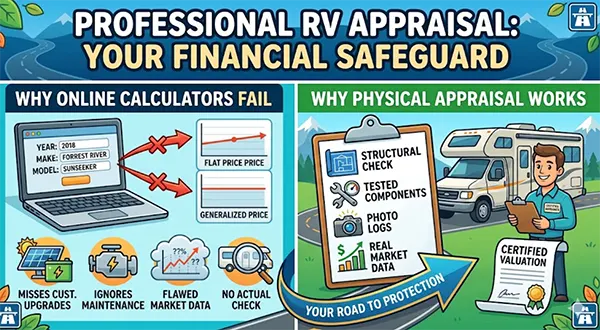
As you can see from this chart, there are some important differences in the way an online calculator works versus an actual physical evaluation.
Critical Roadside Triggers That Demand an Expert On-Site Review
Knowing when the transition between online fast assessment and certification by an appraisal service may help to avoid serious financial losses. You should not learn about your paperwork being too old after an insurance dispute or another emergency situation.
These are some of the cases that call for immediate assistance:
- Private Selling: In case of selling your rig for a large amount of money, you must have all the papers to ensure that you receive the money you need.
- Insurance Issues: If your motorhome were badly damaged by a road accident or any other event, such as a storm, you can use the written document in case your road trip insurance company proposes a poor offer.
- Loans: The banking institution requires certification of the motorhome as an official assessment to receive a loan through auto loan resources and a reasonable interest rate.
- Estate and Tax Documentation: The tax department demands certification when dealing with estate issues or donating the vehicle to a charitable organization.
All these measures will help to prevent various risks and protect your financial situation.
How Does Certified Physical Documentation Outperform a Standard Dealer Quotation?
The quotes given by dealerships will ensure the safety of the dealer’s margins. It means that the dealership will give a very low price for your trade-in, not its true market value. However, the appraiser follows all the procedures to ensure that he is giving his client an unbiased opinion about the value of his motorhome.
A professional appraisal consists of structural testing, clear photos, tested components, and market statistics. Since the document has all the details, it is recognized as valid documentation of the property by insurance companies, banks, and other courts.
Conversely, a cheap appraisal given on the spot by a local car dealer in the form of a sticky note is worthless anywhere except his own car dealership. A professional RV appraisal alone provides you with recognized documents that will safeguard your interests during accidents or sales.
Costly Errors Mobile Home Owners Frequently Make During Asset Valuation
Leaving it until an emergency to find out if you are covered is a huge blunder. Staying ahead will help you save thousands of dollars and prevent long legal hassles.
Did You Know?
The first RVs had handcrafted wooden rooms, built-in light bulbs, and ice boxes!
The following are some of the most common pitfalls you should watch out for:
Trading in Price Mistakes Instead of Retail Value
When using low prices offered by wholesale dealerships, you will lose thousands in the private sector because you will be basing it on the trade price rather than the real retail price.
Failure to Consider the Custom Upgrades
Expensive modifications, such as custom solar panels or lithium batteries, provide no value during valuation since you did not have an official valuation of your investment.
Opinions from People Without Certification
Valuation opinions from friends or relatives without any certification will be turned down immediately by the banks and even insurance firms, as well as the courts.
Along with some travel tips, having the right professional valuation ensures that your mobile property will be fully protected when you go traveling.
Conclusion
In protecting yourself against any unforeseen future circumstances, a simple online estimate and a dealer’s offer of little money on their end are never enough. An actual inspection of the motorhome will guarantee that its accurate price is established, taking into account any modifications and care you have put into it.
Having this paper ready in advance will allow you to avoid huge financial losses and legal troubles later on. Whatever the purpose might be, be it the sale of your motorhome, getting a mortgage, or securing insurance for Florida travel regions, having all these matters covered professionally means full financial safety.
Do not take any chances with your movable asset; invest in a proper assessment to ensure that your savings will not come under risk.
Ques: How much time does a professional physical appraisal of a motorhome take?
Ans: Physical walkthrough of RV takes from 1 hour up to 3 hours, and preparing a report takes three to five days.
Ques: What is the cost of a professional RV valuation?
Ans: The price ranges from $300 to $700, depending on your vehicle’s size and modifications.
Ques: Can I have one report that will be used in various financial transactions?
Ans: Each certified report will be created according to the specific legal/financial matter you need