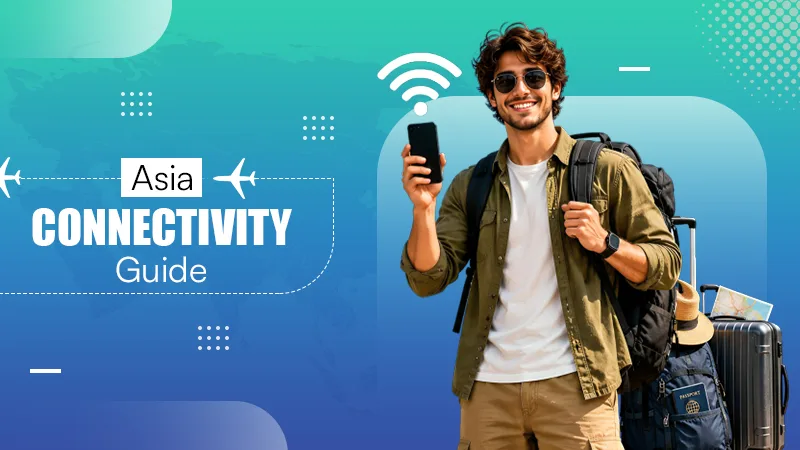
Asia is the ultimate multi-country playground and a dream destination for most backpackers. One trip can easily roll from Bangkok’s street food to Bali’s beaches, a few days in Singapore, then up to Vietnam, and the classic backpacker headache shows up every time you cross a border: but there is one challenge that travellers often face: how do you stay online without hunting for a new SIM card in every airport arrivals hall?
There’s a much easier way now, and it’s worth knowing before you go.
KEY TAKEAWAYS
- An eSIM is a digital SIM already built into most phones from the last few years.
- A regional eSIM simplifies multi-country travel by keeping you connected across several Asian destinations with one plan.
- Regional eSIMs offer flexibility and convenience, letting you top up data online and travel seamlessly throughout Asia.
- Backpackers can save time and stay connected instantly for maps, ride-hailing apps, bookings, and social media updates.
The Old Way: A SIM in Every Country
Buying a local SIM works, but it gets old fast. Every border means finding a shop, queuing, handing over your passport for registration, swapping the tiny plastic card (and not losing your home one), and hoping you guessed the right data amount. Do that five or six times across a trip and you’ve spent real hours — and money — on admin you could’ve skipped.
The Backpacker-Friendly Way: One Regional eSIM
An eSIM is a digital SIM already built into most phones from the last few years. You buy a plan online, scan a QR code, and you’re connected — no physical card, no shop, no passport registration queue.
The real magic for Asia is the regional plan. Instead of a separate SIM per country, one Asia travel eSIM covers around 20 countries across the region on a single plan — so the same eSIM keeps you online as you hop from Thailand to Cambodia to Vietnam to Malaysia without lifting a finger at each border. You set it up once before you fly and forget about it.
That’s a genuine game-changer for the typical Southeast Asia loop, where you might tick off four or five countries in a few weeks.
Spending Most of Your Trip in Thailand?
If Thailand is your main base — or your first stop before the wider loop — a dedicated Thailand eSIM gives you cheap, reliable 4G/5G from the moment you land at Bangkok or Phuket, ideal for Grab rides, hostel bookings, and uploading the obligatory beach content.
How Much Data Do Backpackers Actually Need?
Probably less than you fear, more than you’d like. Maps, messaging, ride apps, social uploads, and the odd video call land most travellers around 1 GB every two or three days. If you’re streaming or hotspotting your laptop for remote work, size up — and the nice thing about an eSIM is you can top up in seconds from wherever you are, no shop required.
Quick Pre-Flight Checklist
Check eSIM Compatibility
Most iPhones from the XS on and recent Samsung/Google phones support it.
Install Before You Fly on Wi-Fi
Two minutes at home beats wrestling with it after a red-eye.
Keep Your Home Number
Keep your home number for calls/texts; use the eSIM purely for data.
For Multi-Country Loops, Go Regional
It’s the single biggest hassle-saver of the whole trip.
Bottom Line
Backpacking Asia is about momentum — chasing the next island, the next night bus, the next plate of pad see ew. Don’t let SIM-card admin slow you down. Sort one eSIM before you go, and the only thing you’ll be switching at each border is your playlist.
In a place where moving from one country to another is as simple as catching a bus ride or taking an affordable plane, it shouldn’t be any more difficult when it comes to making sure that you have proper Internet connectivity wherever you go.
What is an eSIM and how does it work?
An eSIM is a digital SIM built into your phone that can be activated online using a QR code, without needing a physical SIM card.
Can I use one eSIM in multiple Asian countries?
Yes, a regional Asia eSIM works across multiple countries, allowing you to stay connected without changing SIMs.
Will my phone support an eSIM?
Most newer iPhones, Samsung Galaxy devices, and Google Pixel phones support eSIM technology.
Is an eSIM better than buying local SIM cards in each country?
For multi-country trips, an eSIM is often more convenient because it eliminates the need to buy and swap SIM cards at every destination.