
The California-to-Texas corridor is one of the busiest vehicle moves in the country.
Thousands of drivers are being pushed east by job relocations, lower cost of living and remote work.
Most of them don’t want to be driving on I-10 for three days.”
Booking auto transport from California to Texas handles the drive for you, but the process has more moving parts than people expect, and a few small decisions up front can change what you pay and when your car shows up.
Key Takeaways
- The final price depends on the route’s popularity, vehicle size, season, transportation type and schedule flexibility.
- Most transport companies operate through a broker-carrier model, where carriers accept jobs based on route demand.
- Document your vehicle with photos and review the Bill of Lading carefully to protect against disputes.
- Booking early, staying flexible, and using major metro pickup locations can help reduce shipping costs.
How the booking process actually works
Most people start with an online quote, then get flooded with calls from brokers within minutes.
That’s normal.
The car shipping industry runs largely on a broker-carrier model, meaning the company you book with usually isn’t the one driving your vehicle.
Brokers post your job to a national load board and independent carriers bid on your job based on their route.
Once a carrier accepts, you get a pickup window, a driver contact and a locked-in price.
The thing worth understanding is that the quoted price isn’t always the price that books.
If no carrier picks up your load within a few days, your broker will usually come back asking for more money.
This is not a scam, this is how the load board works.
Carriers chase the better-paying jobs first, so a quote that sits too low just sits.
What it costs to ship a car from California to Texas
For a standard sedan on an open carrier, the typical price range runs between $900 and $1,400.
The exact number depends on the cities, the time of year and how flexible you are with dates.
Pricing isn’t a flat per-mile figure; it’s shaped by:
- Route density. Los Angeles to Dallas is cheap because carriers run it constantly. Eureka to Lubbock is expensive because almost nobody does.
- Vehicle size and condition. A lifted truck or a non-running car takes up more deck space and needs winching, both of which cost more.
- Season. Snowbird season (roughly January through March) tightens capacity going south and east, and prices climb.
- Open vs. enclosed. Enclosed trailers run 40 to 60 percent more and are mostly worth it for collector cars, exotics, or anything where paint chips matter.
Pickup, transit, and delivery timing
A realistic pickup window from a major California metro is two to five days after booking.
Transit normally takes three to six days after the car is loaded.
Drivers must abide by hours-of-service regulations and often have other vehicles to drop off on the way. Door-to-door isn’t always a literal.
If your street can’t fit a 75-foot rig, the driver will meet you at a nearby parking lot.
This is standard, not a service failure.
Inspection and the Bill of Lading
When the carrier arrives, they’ll walk around the car with you and mark any existing damage on the Bill of Lading.
This document matters.
Take your own photos in good light before pickup and again at delivery with timestamps.
If anything happens in transit, the BOL & your photos is what an insurance claim runs on.
Sign nothing at delivery until you’ve actually looked the car over, even if the driver is in a hurry.
A few things that quietly save money
- Book about two weeks out. Last-minute jobs pay a premium, while bookings further out get more carrier interest at a fair rate.
- Stay flexible on dates. A three-to-five-day pickup window almost always beats a single fixed day.
- Ship from a big metro area if you can. You can save a couple hundred bucks by driving your car to Los Angeles or San Diego and picking up a route that starts somewhere in the boondocks.
- Empty the car, mostly. Carriers technically aren’t licensed to haul household goods, and overloaded vehicles risk damage and DOT issues. A small bag in the trunk is usually fine; a packed cabin is not.
Choosing a company without getting burned
Look for a valid USDOT and MC number, and check it on the FMCSA’s SAFER website.
Read recent reviews only! The car shipping industry has a lot of turnover and a company’s reputation can change in six months.
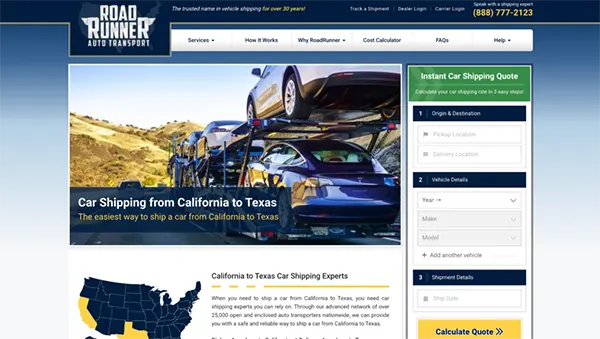
Larger national companies like Montway, Sherpa and Road Runner Auto Transport usually have more consistent carrier networks on busy lanes, but smaller brokers can compete on price if you’re flexible.
Be wary of quotes that come in dramatically below everyone else’s.
That’s almost always a number designed to win your booking, not move your car.
Putting it all together
Shipping a vehicle across the country isn’t complicated once you understand the moving parts.
Get a few quotes, pick a middle-of-the-pack price from a company with a real track record, be flexible on your pickup window and document the car carefully at both ends.
Do that, and the Texas driveway part takes care of itself.
What is the cheapest way to move from California to Texas?
Renting a truck and driving yourself is the cheapest way to move from Los Angeles to Texas.
What is the 3-second rule in California?
Use the three-second rule to ensure a safe following distance and avoid a collision.
What is the 7 minute rule in California?
Some California wage laws also closely follow federal law. Under federal law, an employer can round down working time lasting seven minutes or less.
What is the golden rule of driving in California?
The golden rule of driving is to treat other drivers the way you want to be treated. You should obey traffic laws, drive responsibly, and avoid taking unnecessary risks.