
- Planning the Route: What This Itinerary Covers
- Stop 1: Rocky Mountain National Park, Colorado
- Stop 2: Arches National Park, Utah
- Stop 3: Canyonlands National Park, Utah
- Stop 4: Bryce Canyon National Park, Utah
- Stop 5: Zion National Park, Utah
- Stop 6: Grand Canyon National Park (South Rim), Arizona
- Stop 7: Monument Valley, Utah/Arizona Border
- Stop 8: Grand Teton National Park, Wyoming
- Stop 9: Yellowstone National Park, Wyoming/Montana
- Stop 10: Glacier National Park, Montana
- Tying the Loop Together
Choosing an itinerary for your road trip is a hectic task, with constant stops and no idea of what the roads hold for you. Starting off as a prepared individual is important.
This is because the itinerary defines how your road trip experience will be.
It’s designed for RVers who want more than a checklist — real drive-time planning, campground strategy, and the small logistical details that make the difference between a smooth trip and a stressful one.
Read further to explore more!
Planning the Route: What This Itinerary Covers
The loop starts in Colorado, cuts southward through Utah’s canyon country, dips into Arizona, and then arcs north through Wyoming and Montana before looping back. It totals roughly 2,800 miles, depending on the selected campgrounds chosen at each stop.
A few ground rules worth establishing before departure:
- Book campgrounds early. National park campgrounds inside Utah’s “Mighty 5” and Yellowstone routinely fill up 4-6 months ahead in peak season.
- Budget extra drive time in mountain terrain. Google Maps predictions rarely account for grade, wind, or towing a trailer.
- Fuel up before, not during, remote stretches. Several legs of this route extend 60+ miles without services.
Stop 1: Rocky Mountain National Park, Colorado
Suggested stay: 2 nights
Rocky Mountain National Park is the natural starting point for a westbound loop out of Denver. Trail Ridge Road, the highest continuous paved road in the U.S., climbs above 12,000 feet and offers some of the most dramatic alpine views accessible by RV — though larger rigs should check the length restrictions before committing to the full crossing.
Moraine Park Campground is the most RV-friendly choice inside the park, with sites that accommodate larger units and a shuttle system that removes the need to drive into the more congested areas.
Stop 2: Arches National Park, Utah
Drive time from Stop 1: ~6.5 hours
Suggested stay: 2 nights
Arches features over 2,000 documented stone arches into a relatively compact desert landscape, which makes it one of the most photogenic and least physically demanding parks on this list. Delicate Arch is the signature hike, but it’s a 3-mile round trip with real elevation gain and almost no shade — an early morning start is worth the discomfort of a pre-dawn alarm.
Because in-park camping is restricted, most RVers stage out of Moab, which has a dense cluster of private campgrounds with full hookups, something the park’s own campground doesn’t offer.
Stop 3: Canyonlands National Park, Utah
Drive time from Stop 2: ~45 minutes
Suggested stay: 1-2 nights
Canyonlands is Arches’ quieter, more remote neighbor, and it rewards visitors with far fewer crowds. The Island in the Sky district is the most convenient section for RVs, with paved roads leading to overlooks like Grand View Point that stretch for what feels like the entire state.
Since this stop sits so near to Moab, many travelers base out of the same campground used for Arches and simply drive in for the day — a good way to cut down on setup and teardown time mid-trip.
Stop 4: Bryce Canyon National Park, Utah
Drive time from Stop 3: ~4.5 hours
Suggested stay: 2 nights
Nothing quite readies first-time visitors for the hoodoos of Bryce Canyon — the tall, thin rock spires that fill the amphitheatre below the rim. The elevation here (over 8,000 feet at the rim) means overnight temperatures fall sharply even in summer, so packing layers matters more here than at almost any other stop on this route.
North Campground, inside the park, is accessible to the rim and one of the more scenic places to wake up on the entire trip, though larger rigs may find some sites tight.
Stop 5: Zion National Park, Utah
Drive time from Stop 4: ~2 hours
Suggested stay: 2-3 nights
Zion is arguably the centerpiece of the Utah leg. The canyon walls tower over 2,000 feet on either side of the Virgin River, and the park’s shuttle system means most visitors won’t drive their RV once they’re settled — a relief after the previous few days of near-daily repositioning.
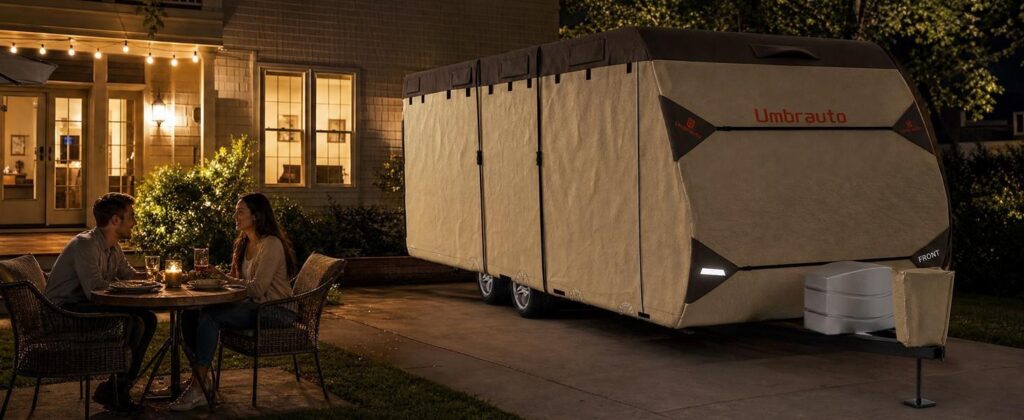
This is also a good point in the trip to think about protecting the rig during longer stationary stretches. Desert sun and sudden wind gusts are hard on exposed surfaces, and travelers parked for multiple nights often find it worth throwing on a Umbrauto’s weatherproof RV cover whenever the rig is sitting unused for a full day of hiking, especially during the dustier spring and fall shoulder seasons.
Stop 6: Grand Canyon National Park (South Rim), Arizona
Drive time from Stop 5: ~4.5 hours
Suggested stay: 2 nights
The South Rim is the most accessible side of the Grand Canyon for RVs, with Trailer Village offering full hookups within walking distance of the rim itself. Even repeat visitors tend to underestimate how long it takes to quietly stand and look — budget more time at the overlooks than seems necessary on paper.
Desert View Drive, running along the eastern boundary of the park, is a quieter alternative to the main visitor center corridor and a good choice for RVers who’d rather avoid the busiest parking areas.
Stop 7: Monument Valley, Utah/Arizona Border
Drive time from Stop 6: ~2.5 hours
Suggested stay: 1 night
Monument Valley sits on Navajo Nation land, and the sandstone buttes here are widely recognizable from decades of film and photography. The Valley Drive loop is a rough, unpaved 17-mile road that isn’t RV-friendly, so most travelers observe the formations from The View Campground or book a guided tour with a local Navajo operator instead of attempting it in a larger rig.
This is a brief stop by design — one sunset and one sunrise here is usually enough to justify the detour before continuing north.
Stop 8: Grand Teton National Park, Wyoming
Drive time from Stop 7: ~7 hours
Suggested stay: 2 nights
The jump north into Wyoming is the longest single drive of the trip, but it marks a clear transition in scenery — from desert canyon country to alpine lakes framed by jagged peaks. Jenny Lake is the park’s highlight, and the lack of foothills in front of the Teton Range means the mountains rise almost straight up from the valley floor, a view that photographs never quite convey.
Gros Ventre Campground tends to have more openings than the more popular Jenny Lake sites and still offers easy access to the park’s main attractions.
Stop 9: Yellowstone National Park, Wyoming/Montana
Drive time from Stop 8: ~1 hour
Suggested stay: 3-4 nights
Yellowstone warrants the longest stay of the trip. Between the geothermal features around Old Faithful, the wildlife-dense Lamar Valley, and the canyon overlooks in the park’s northern section, three or four days is a baseline, not a luxury.
Fishing Bridge RV Park is one of the few full-hookup facilities inside the park itself, and it books out fast — reserve this one as early as any campground on the list.
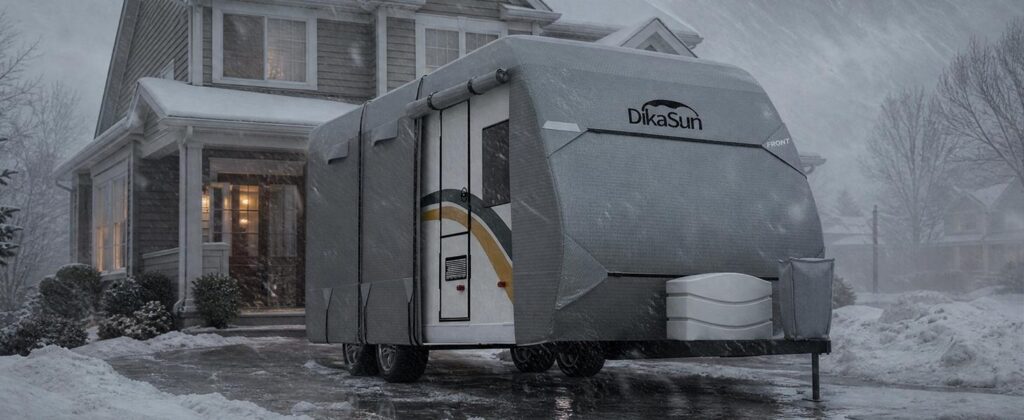
Long stationary stays here also make it worth inspecting the rig’s wheels before continuing on. After thousands of miles of mixed terrain, a set of tough DikaSun’s tire covers can help protect tires from UV exposure during the days spent parked and exploring on foot, which matters more here than almost anywhere else on the route given the elevation and sun exposure.
Stop 10: Glacier National Park, Montana
Drive time from Stop 9: ~6.5 hours
Suggested stay: 2-3 nights
Glacier completes the loop, and Going-to-the-Sun Road is the reason most RVers put it on the list in the first place — though vehicle length restrictions apply on the alpine section, so check current limits before planning to drive it in a larger rig.
Fish Creek Campground on the west side offers a good mix of convenience and proximity to the park’s most photographed viewpoints, including Lake McDonald.
Tying the Loop Together
From Glacier, most travelers either continue the loop back toward Colorado through Idaho and Wyoming, or treat this as the natural conclusion and arrange a return route based on how much time is left.
A trip like this covers a huge range of elevation, climate, and terrain in a short period, which is exactly why the logistics matter as much as the scenery. Reserve early, build in buffer days for weather and fatigue, and don’t be afraid to shorten a stop short if the group needs a rest day — the West will still be there next time.
Can you sleep anywhere in an RV in the USA?
In most states, you can stay one night at rest areas. Notices at the rest area entrance will show how long you can stay, often 8 to 12 hours.
How do people shower in a camper?
RVs may come equipped with a hot and cold water supply for both indoor and outdoor showers.
Does India allow me to take $10,000 to the US?
You can carry up to USD 3,000 in cash under RBI rules. However, the USA requires declaration of USD 10,000 or more brought into the country.
Can you go wild camping in America?
Most people don’t realize you can legally camp in some of the most beautiful places in the U.S… for free. It’s called wild camping (also known as dispersed camping) and it means camping outside of developed campgrounds on public lands like National Forests or BLM land.