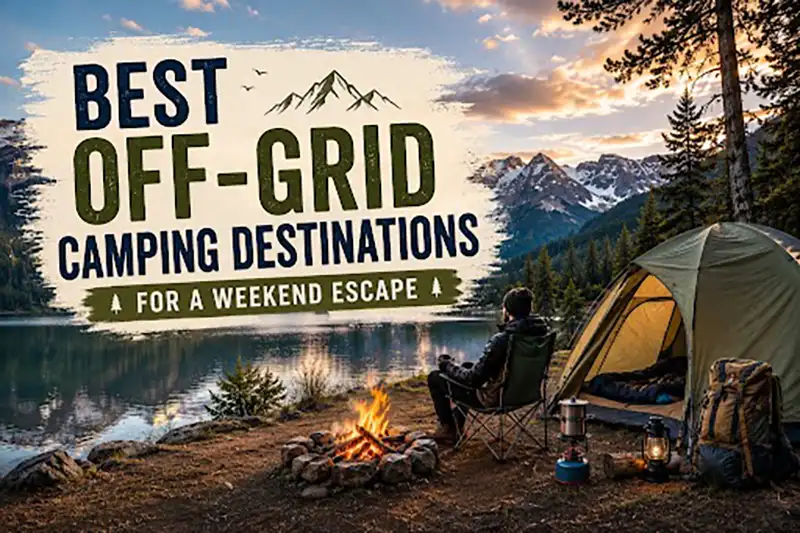
There’s a specific kind of quiet that only shows up once the last cell bar disappears. No neighboring campsites, no generator hum three spots over, no line for the bathhouse — just open land and whatever’s already in the rig.
That’s the appeal of off-grid camping, also known as boondocking or dispersed camping: setting up somewhere with no hookups, no reservations, and often no other people. It takes a bit more planning than pulling into a state park, but the payoff — genuine solitude within a weekend’s reach — is worth the extra prep.
This guide covers some of the best off-grid destinations across the U.S., what permits actually require, and what belongs on a boondocking packing list before heading out.
What “Off-Grid Camping” Actually Means
Off-grid camping generally falls into two categories, and knowing the difference matters before choosing a destination.
Dispersed camping happens on public land — typically Bureau of Land Management (BLM) or National Forest land — where camping is allowed outside of designated campgrounds, usually for free. There are no hookups, no picnic tables, and often no marked sites at all.
Boondocking is a broader term that covers any camping without hookups, including overnight parking in more developed but unserviced spots. Every dispersed camping trip is boondocking, but not every boondocking trip is on public land.
Understanding which category a destination falls into determines what permits, if any, are required.
Do You Need a Permit for Off-Grid Camping?
It depends entirely on the land manager, and this is the part most first-timers get wrong.
- BLM land: Most BLM dispersed camping doesn’t require a permit, but some high-traffic areas (like parts of Sedona and the Alabama Hills) have implemented day-use or camping permits due to overcrowding.
- National Forest land: Generally permit-free for dispersed camping, though some forests require a free self-issued permit at trailhead kiosks, and stay limits (commonly 14 days) apply.
- State-managed public land: Rules vary widely by state — some allow dispersed camping outright, others require a specific dispersed-use permit.
The safest habit: check the specific ranger district or BLM field office website before every trip, since rules can change seasonally, especially around fire restrictions.
6 Off-Grid Camping Destinations Worth the Drive
1. Alabama Hills, California
Just outside Lone Pine, the Alabama Hills offer dramatic rock formations with the Sierra Nevada as a backdrop — a landscape familiar to anyone who’s watched a Western film, since it’s been a filming location for decades. BLM dispersed sites here are plentiful, though a permit is now required for overnight stays due to heavy visitation.
2. Valley of the Gods, Utah
A quieter, less-visited alternative to nearby Monument Valley, Valley of the Gods sits on BLM land with a 17-mile dirt loop road connecting scattered, informal campsites among the sandstone buttes. No permit is required, and the isolation here is significant — cell service is essentially nonexistent.
3. Alvord Desert, Oregon
One of the most remote entries on this list, the Alvord Desert is a dry lakebed in southeastern Oregon known for its stargazing and stark, wide-open horizon. There’s no fee, no permit, and no services for miles, which means arriving fully self-sufficient isn’t optional — it’s the only way this destination works.
4. San Juan National Forest, Colorado
For campers who want elevation and forest cover rather than desert exposure, San Juan National Forest offers dispersed sites along forest roads at elevations that keep summer temperatures noticeably cooler than the surrounding lowlands. A free permit is required in some ranger districts, so it’s worth confirming ahead of time.
5. Mojave National Preserve, California
Less crowded than nearby Joshua Tree, the Mojave National Preserve allows dispersed camping within a quarter mile of most backcountry roads. The preserve’s size means solitude is nearly guaranteed on a weekend trip, even during peak season.
6. Coconino National Forest, Arizona
Bordering Sedona, Coconino National Forest offers dispersed camping with red rock views similar to the town’s paid campgrounds, without the crowds or cost. Some corridors near Sedona now require a permit due to overcrowding, so checking current restrictions before arrival is essential.
What to Pack for Boondocking
Off-grid camping removes the safety net of hookups, potable water, and nearby help, which changes the packing list significantly compared to a standard campground trip.
Power and water:
- Fully charged house batteries or a solar setup, since there’s no shore power to rely on
- More water than seems necessary — a good baseline is one gallon per person per day, plus extra
- A water filtration system as backup
Navigation and safety:
- Offline maps downloaded in advance, since cell service is often nonexistent
- A physical paper map as backup to any GPS device
- A basic first aid kit stocked beyond the minimum, given the distance to help
Comfort and setup:
- Extra fuel or propane, since remote areas rarely have a station within easy reach
- Leveling blocks, since dispersed sites are rarely flat
- A weatherproof RV cover for extended stays, since exposed sites often mean full sun and wind with no tree cover — a protective RV cover by Umbrauto helps shield the exterior from UV damage and dust during a multi-day stay without hookups
Waste management:
- A portable waste tank or established plan for gray/black water, since dumping isn’t available on-site
- Trash bags and a pack-it-out mindset — leave-no-trace principles matter even more in unmonitored areas
A Note on Leave No Trace
Off-grid destinations stay open to camping because visitors treat them responsibly. That means packing out all trash, using existing fire rings instead of creating new ones, keeping campsites within already-disturbed footprints rather than driving off-road to create new tracks, and burying human waste at least 200 feet from any water source.
The places on this list remain remote and uncrowded specifically because the people who visit them tend to respect that quiet. It’s worth keeping it that way.
Protecting the Rig Between Trips
Weekend boondocking trips often mean the rig sits between adventures more than it’s actually driven — parked in a driveway or storage lot until the next escape. Dust, sun, and moisture do quiet damage during those idle stretches, and a set of durable tire covers by DikaSun can help prevent UV cracking on tires that otherwise sit exposed between trips, which matters more than most owners realize until a slow leak shows up right before the next departure.
Planning the Next Escape
Off-grid camping rewards a little extra homework — checking permit requirements, packing for total self-sufficiency, and choosing a destination that matches the rig’s capabilities. In return, it offers something increasingly hard to find: a weekend with no schedule, no neighbors, and no signal, just open land and a clear sky.
Start with one destination from this list, confirm the current rules for that specific area, and build the packing list around genuine self-sufficiency. The rest tends to take care of itself.
What should I pack for an off-grid adventure?
The following things are essential:
- Power and water supplies
- Navigation and safety gear
- Waste management items
- Comfort and setup gear
What should I know before visiting off-grid destinations?
Off-grid destinations remain open for camping as visitors treat them responsibly. This means packing out all trash, using existing fire rings rather than creating new ones, and keeping campsites contained.
How can I protect the rigs between trips?
Dust, sun, and moisture do quiet damage during those idle stretches, and a set of durable tire covers can help prevent UV cracking on tires that otherwise sit exposed between trips.