- The True Baseline Cost of a Safe and Dependable Ebike
- Ebike Price Ranges Explained Across Four Market Tiers
- Cheap vs Expensive Ebike Comparison and Critical Safety Cutbacks
- Reliable Folding Ebike Cost Factors and Mechanical Trade-Offs
- Ebike Component Cost Drivers from Battery Chemistry to Motors
- Hidden Costs of Owning an Ebike Beyond the Purchase Price
- Pre-Purchase Ebike Budget Checklist and Comparison Matrix
- Final Words
Buying a two-wheeler is a major decision in India. Whether you’re a young college student or adult professional, everyone needs a two-wheeler for travelling. Bike dealers work under more pressure than car dealers every year in the country.
But spend money on e-bike is really reliable in 2026 or not, it can be an effective question. If you’re thinking of buying an e-bike, go through the article to check your budget and reliability.
The True Baseline Cost of a Safe and Dependable Ebike
The physical cost of manufacturing a safe, roadworthy electric bike in Europe has developed considerably with the rise of modern direct-to-consumer engineering.
Traditionally, brick-and-mortar bicycle franchises set pricing floors above €1,500 due to multi-tiered wholesaler margins and sell markups that add 40% to 50% to the final price. Today, established direct-to-consumer makers deliver fully certified EN 15194 European electric bikes starting between €600 and €900 by shipping directly from factory manufacturing lines to consumers.
Investing in a dependable e-bike engineered with certified battery cells, reactive disc brakes, and a street-legal 250W motor ensures daily road safety without paying for traditional dealer markups. The true safety dangers exist in generic, grey-market imports sold under €500 through non-expert online storefronts, which frequently omit compulsory European electrical testing.
Moreover, independent European bicycle repair shops regularly decline service on unbranded generic electric bikes due to accountability concerns surrounding uncertified electrical systems. Buying a certified e-bike above €600 ensures your bicycle uses consistent mechanical parts and certified battery management systems that professional European bike mechanics can service safely.
Ebike Price Ranges Explained Across Four Market Tiers
Navigating ebike price ranges explained across modern market categories helps potential buyers align realistic budgets with practical commuting demands. The European electric bicycle market divides into four distinct pricing tiers, each described by specific hardware capabilities and component lifetime:
- Sub-€500 (The Unregulated Grey-Market Hazard): Unidentified direct imports utilizing generic battery cells, entry-level mechanical cable disc brakes, and generic electronics. These models lack documented EN 15194 certification and offer limited replacement part availability.
- €600 to €1,200 (The Direct-to-Consumer Value Sweet Spot): The ideal value tier for everyday transportation. Buyers secure tier-one battery cells (Samsung, LG), responsive circle brakes, street-legal 250W geared hub motors, multi-speed Shimano gearing, and verified EN 15194 observance from direct-sales brands.
- €1,200 to €2,500 (Mid-Range and Integrated Commuters): Higher-end city and touring bicycles highlighting mid-drive motors, unified torque sensors, internal gear hubs, low-maintenance carbon belt drives, and combined lighting systems.
- €2,500 and Above (Specialized Luxury and Performance): committed electric mountain bikes (eMTBs), heavy-duty commercial cargo carriers, and ultralight carbon fiber road frames furnished with top-tier Bosch, Brose, or Shimano Steps drive units.
For most daily commuters, spending within the €700 to €1,200 range covers 95% of practical transportation needs without sustaining the steep depreciation related to luxury performance hardware.
Cheap vs Expensive Ebike Comparison and Critical Safety Cutbacks
Conducting a methodical cheap vs expensive ebike comparison discloses that bargain models under €500 reduce retail costs primarily by cutting corners on invisible safety elements. Battery engineering represents the most critical difference between cheap and well-built electric bicycles.
Quality manufacturers gather battery packs using automated welding, flame-retardant cell holders, and intelligent Battery Management Systems (BMS) that actively balance cell voltages and prevent warm runaway. Sub-€500 bikes frequently cut costs by utilizing generic or recycled lithium cells with elementary protection circuits, significantly inspiring fire risks during indoor charging.
Braking hardware marks the second dangerous compromise. An electric bicycle weighs between 22 and 30 kg, creating considerable kinetic energy at 25 km/h when combined with rider weight and traveling load.
High-quality commuter bikes equip dual disc brakes with 180 mm steel blades that generate consistent stopping force with light strategic effort. Ultra-cheap models replace delicate mechanical cable-pull disc brakes that suffer from rapid cable stretch, pad polishing, and intense slowdown fade on wet drops.
Frame manufacturing standards also reflect this price gap. Respected frames undergo everyday stress testing and utilize heat-treated 6061 aluminum with smooth bond transitions to prevent structural exhaustion. Cheap frames often feature thin-walled pipe and uneven hand welds that can crack under recurrent road movement.
Reliable Folding Ebike Cost Factors and Mechanical Trade-Offs
Calculating a dependable folding ebike cost requires accounting for the engineering premium demanded by specialized frame joints and compact mechanical patience.
Folding frames place massive physical strain on a central joint mechanism, which must tolerate thousands of microscopic twisted flexes during daily pedaling and braking. If a manufacturer builds a folding frame with subpar alloys or loose latching hardware, the frame develops obvious play and direction stumble within a few months of urban use.
When shopping for a close folding ebike designed for apartment storage or train connections across European cities, allocating between €700 and €1,200 ensures you get hale aluminum alloy joints and brand-name lithium cells rather than dangerous structural compromises. A well-engineered folding bicycle integrates a strengthened quick-release brace and compact battery compartments that protect electrical cables from being drawn during folding cycles.
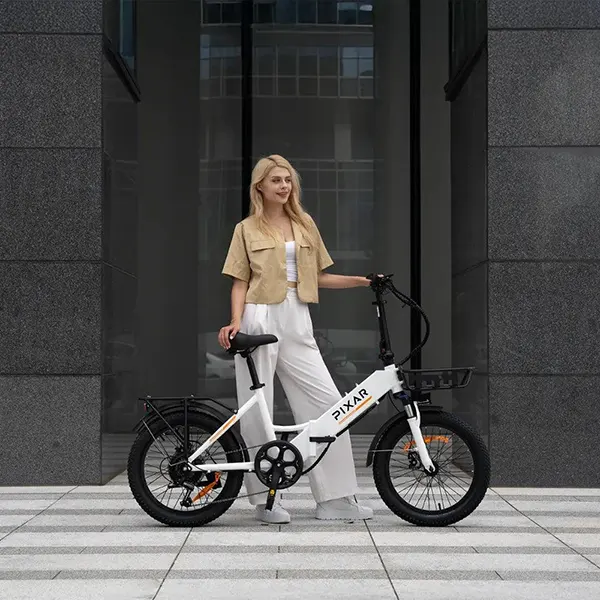
Practical folding commuters, exemplified by 20-inch wheel setups like the PIXAR Rusher with a 48V Samsung battery pack and 250W BAFANG geared motor—strike an ideal balance between movable folded dimensions (84 × 51 × 79 cm) and road steadiness. While spending under €500 on a folding bike might appear attractive, replacing exhausted hinge pins and bent stems quickly nullify any initial savings.
Ebike Component Cost Drivers from Battery Chemistry to Motors
Understanding underlying hardware costs helps buyers identify genuine value when researching how much to spend on an ebike. Battery capacity calculated in Watt-hours directly influences overall retail pricing.
A modest 360Wh battery keeps a bike lightweight and affordable, while intensifying to a high-capacity 650Wh or dual-battery architecture adds €150 to €300 to the build cost. Paying extra for premier cells from Samsung, LG, or Panasonic pays returns in long-term battery health, as these cells comfortably maintain 70% to 80% capacity across 500 to 800 charge cycles.
Motor placement and architecture represent another major price driver:
- Geared Hub Motors (€120 to €200 Component Cost): Placed directly in the rear wheel, geared hub motors provide simple, dependable drive that bypasses the bicycle chain. They offer outstanding efficiency and minimal maintenance for flat to fairly rolling urban commutes.
- Mid-Drive Motors (€350 to €700 Component Cost): Mounted at the crank assembly, mid-drive motors drive the bicycle’s mechanical gears, multiplying twist on steep slopes and delivering a centered weight distribution.
Sensor technology also impacts manufacturing expense. Basic pulse sensors function like an on-off switch, engaging the motor after discover pedal rotation.
In contrast, advanced torque sensors measure foot pressure powerfully hundreds of times per second to deliver natural, proportional support. While torque sensors add €70 to €130 to the retail price, they significantly improve battery efficiency and ride quality.
Hidden Costs of Owning an Ebike Beyond the Purchase Price
Allowing for the hidden costs of owning an ebike prevents unexpected budget shortfalls and ensures you have all essential gear on your first ride. Potential buyers should reserve an additional 10% to 15% (€80 to €180) outside the purchase price for essential safety and security equipment:
- Heavy-Duty Lock (€60 to €120): Electric bikes are primary targets for theft. A standard plaited cable lock can be trimmed in seconds; an angle-grinder-resistant U-lock or heavy tempered steel chain is a mandatory investment.
- Certified Helmet (€40 to €90): Higher continuous commuting speeds justify a helmet certified to modern European impact standards with revolving impact protection.
- Commuting Accessories (€40 to €100): Waterproof pouches, rear cargo straps, and high-visibility clothing expand daily usefulness.
Routine maintenance and operating expenses remain extremely modest over time. Annual maintenance, primarily comprising brake pad replacements (every 1,000 to 1,500 km at €20 to €35 a set), chain greasing, and periodic gear tuning—typically totals €80 to €120 per year.
Charging expenses are virtually insignificant. Recharging a standard 500Wh battery pack requires roughly 0.5 kilowatt-hours of electricity, price approximately €0.15 to €0.25 per complete cycle in Europe.
Compared to monthly public transit passes (€49 Deutschlandticket or €70–€90 urban passes) or automobile ownership (fuel, parking, insurance exceeding €2,500 annually), a dependable electric bike repays its entire purchase price within six to twelve months.
Pre-Purchase Ebike Budget Checklist and Comparison Matrix
Reviewing a structured ebike budget listing ensures your final purchase balances mechanical strength against upfront investment. Prospective buyers learning how much to spend on an ebike should systematically compare requirements across market segments to avoid paying for unnecessary features.
The following comparison framework outlines how key specifications align across common pricing tiers in Europe:
E-Bike Price Tier Comparison: Price, Hardware Specs, and Expected Lifespan (2026 Matrix)
| Price Tier | Typical Component Specifications | Battery & Motor Quality | Braking System | Expected Lifespan | Best Suited For |
| Under €500 | Stamped steel/generic alloy, basic gears | Unbranded cells (300–400Wh), generic hub motor | Mechanical cable disc brakes | 1 to 2 years | Occasional flat neighborhood use |
| €600 – €1,200 | 6061 Aluminum, Shimano 7-speed, integrated lights | Certified Samsung/LG (450–650Wh), 250W hub motor | Dual disc brakes (180mm rotors) | 4 to 7 years | Daily city commuting, errands, folding |
| €1,200 – €2,500 | Hydroformed alloy, internal hubs, belt drive | High-capacity certified packs, entry mid-drive motor | Quad-piston hydraulic disc brakes | 6 to 9 years | Heavy commuters, hilly routes, cargo |
| €2,500+ | Carbon fiber/premium alloy, electronic shifting | Integrated dual batteries (750Wh+), Bosch mid-drive | High-end hydraulic disc systems | 8+ years | Specialized eMTB, commercial cargo |
Before placing an order, reference your shortlisted models against this essential pre-purchase inspection checklist:
- Electrical Safety Documentation: Verify documented EN 15194 European compliance marks and CE compliance.
- Branded Battery Chemistry: Confirm the manufacturer directly specifies tier-one cells (Samsung, LG, or Panasonic).
- Disc Braking System: Ensure the bike features dependable disc brakes with motor obstacle cutoff levers.
- Realistic Torque Ratings: Look for motors rated between 40 and 60 Nm of twist rather than depending solely on wattage claims.
- Replacement Part Access: Confirm the brand offers direct replacement batteries, brake pads, and supervisors within Europe.
- Warranty Terms: Require at least a detailed two-year warranty covering frame, motor, and battery.
Final Words
Navigating how much to spend on an e-bike in Europe requires ranking mechanical lifespan and certified battery safety over dealer brand premiums or bottom-dollar unauthorized bargains. Setting a realistic budget between €600 and €1,500 delivers a reliable, fully certified European commuter equipped with disc brakes and dependable range.
By focusing your investment on high-quality battery cells and sturdy frame construction, you obtain a dependable personal vehicle that pays for itself many times over in saved passage and fuel costs.
Why should I avoid buying an e-bike priced under €500?
Sub-€500 models inevitably cut critical corners by using uncertified lithium battery cells lacking thermal runaway protection, fragile mechanical brakes, and generic electronics that European bike repair shops refuse to service.
How much should you spend on a reliable folding ebike?
A reliable folding electric bike in Europe costs between €700 and €1,200. This budget accommodates high-tensile aluminum folding latches that resist metal fatigue, name-brand battery cells, and stable 20-inch tires suitable for daily multi-modal transit.
Can you get a dependable commuter e-bike in Europe for under €1,000?
Yes. Modern direct-to-consumer brands deliver high-quality, fully certified EN 15194 pedelecs between €600 and €1,000 by eliminating traditional dealer and importer markups, offering reliable 250W motors, brand-name batteries, and disc brakes.
How much does it cost to charge an e-bike battery for a full year?
Charging an average 500Wh e-bike battery in Europe costs approximately €0.15 to €0.25 per cycle, depending on local electricity rates. For a commuter riding 4,000 kilometers annually, the total yearly charging cost is typically under €25, representing negligible running expenses.
How much should I budget for an e-bike replacement battery?
Replacement battery packs from reputable European distributors cost between €300 and €500 depending on capacity and brand-name cells (Samsung/LG). High-quality batteries last 500 to 800 charge cycles, meaning replacement is typically only needed after three to five years.