- Where Does the Manaslu Circuit Go?
- Why Do Trekkers Pick Manaslu Over Annapurna or Everest?
- What Permits Does the Manaslu Circuit Require?
- How Hard Is Larkya La Pass?
- When Is the Best Time to Trek Manaslu?
- What Does Accommodation and Food Look Like?
- How Does Manaslu Compare to Other Nepal Treks?
- What Should Be Packed Specifically for This Route?
- Key Takeaways
The Manaslu Circuit is a popular place for trekking and is around the world’s eighth-highest mountain, after crossing the Lark La pass. You have to get permission to visit the place. It is a high-altitude trek in Nepal. Explore why this trek is famous among Annapurna or Everest, how hard it is, what the famous food is there, and many more things. If you’re planning a trip to the Manaslu Circuit, then go through this article; it will help you plan your trip.
Where Does the Manaslu Circuit Go?
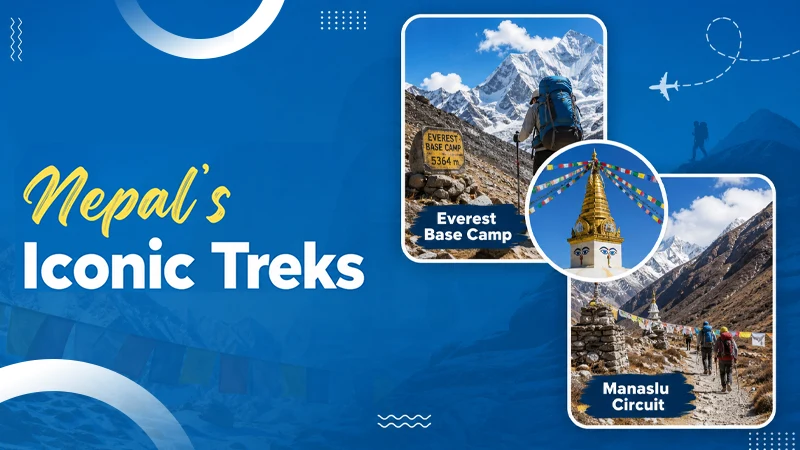
The route starts at Machha Khola or Soti Khola in Gorkha district, and follows the Budhi Gandaki gorge upriver through Jagat and Deng, and climbs into Tibetan-influenced villages at Lho, Shyala and Samagaun. From there it crosses Larkya La and drops into the Annapurna region at Dharapani, where a jeep road carries trekkers out to Besisahar.
The slope tells the story better than the map. Machha Khola sits near 870 m and Samagaun near 3,530 m, so the first week is a long, moist river walk through subtropical forest before the terrain turns dry and towering in a single day of climbing above Lho.
Why Do Trekkers Pick Manaslu Over Annapurna or Everest?
Three reasons come up frequently in trailhead conversations:
- Trail traffic. Permit figures for Manaslu run in the low thousands per season against tens of thousands for Everest and Annapurna.
- Cultural variety in one route. Hindu farming villages at the bottom, Tibetan Buddhist agreement with gompas and mani walls at the top.
- A real pass crossing. Larkya La is a nine- to eleven-hour day, not an optional side trip.
The trade-off is organization. Flexibility disappears once a restricted-area permit is issued for fixed dates, and the first three days involve slide-prone sections that operators running the Manaslu Circuit monitor through local staff rather than from Kathmandu.
What Permits Does the Manaslu Circuit Require?
Three separate documents, all arranged by the agency:
| Permit | Covers | Approximate Cost |
| Manaslu Restricted Area Permit | Jagat to Dharapani | USD 100 for 7 days (Sept to Nov.), USD 75 (Dec to Aug), plus daily extensions |
| Manaslu Conservation Area Permit | Philim Onward | NPR 3,000 |
| Annapurna Conservation Area Permit | Dharapani Exit Section | NPR 3,000 |
The restricted-area rule carries two conditions that catch solo travellers out: a minimum of two trekkers on one permit, and a government-licensed guide for the whole restricted area. Agencies pair solo planners with other clients to meet the two-person rule, so a single traveller can still join, just not walk in alone.
How Hard Is Larkya La Pass?
Harder than the altitude alone suggests. The standard plan leaves Dharamsala at 4,460 m between 3 and 4 am, gains roughly 650 m over hill and snow to the pass, then loses about 1,500 m on a steep, loose drop to Bimthang. Wind on the west side after late morning is the reason for the first-light start.
Preparation that holds up on the day:
- Two adjustment nights at Samagaun, with a day hike to Birendra Lake or Pungyen Gompa
- Traction footwear carried from mid-October onward, since the fall ices over
- Trekking poles for the Bimthang side, where the knees take the load
- A hard turnaround plan, because the pass closes in fresh snow and the only alternative is turning back the whole valley
When Is the Best Time to Trek Manaslu?
Late September to late November gives stable weather, clear mountain views, and the busiest teahouses, with Larkya La usually snow-free into early November. March to May brings rhododendron forest in the lower valley and warmer nights, at the cost of afternoon fog.
Monsoon months from June to August make the Budhi Gandaki section genuinely dangerous due to landslides, and winter crossings depend on snowfall, with the pass frequently blocked through January and February.
What Does Accommodation and Food Look Like?
Teahouses cover the entire route now, which was not true a decade ago. Expect twin rooms with plywood walls and shared thickset toilets below Samagaun, slightly better cabins in Samagaun itself, and a single basic open-ward stop at Dharamsala before the pass.
Practical details worth planning around:
- Dal bhat costs NPR 500 to 900 depending on altitude, with free refills
- Hot showers and device charging carry fees of NPR 200 to 500 above Jagat
- No ATMs past Arughat, so cash for the whole trek comes from Kathmandu
- Mobile coverage is patchy from Deng onward and absent around the pass
How Does Manaslu Compare to Other Nepal Treks?
| Trek | Days | Max altitude | Crowd level |
| Everest Base Camp | 12 to 14 | 5,545 m (Kala Patthar) | High |
| Manaslu Circuit | 14 to 16 | 5,106 m (Larkya La) | Low |
| Annapurna Circuit | 12 to 18 | 5,416 m (Thorong La) | Moderate |
Trekkers who want Himalayan scale without a restricted-area authorize tend to look at the Everest side first. Those extending a Khumbu trip add the Gokyo Lake detour for the turquoise basin and the Ngozumpa glacier crossing, which gives a comparable sense of space to Manaslu’s upper valley.
What Should Be Packed Specifically for This Route?
Standard high-altitude kit applies, with a few Manaslu-specific additions:
- A sleeping bag rated to minus 15 C, since Dharamsala blankets are thin
- Water purification, because bottled water sales are restricted in the conservation area
- A 2 to 3 litre carrying capacity, as taps between Deng and Namrung are far apart
- Rain protection for the lower valley even in autumn, where the gorge holds moisture
Key Takeaways
- Restricted-area permit required, issued only through a registered agency with a licensed guide and two or more trekkers
- 14 to 16 days, with Larkya La at 5,106 m as the single hardest day
- Best windows are late September to late November and March to May
- Teahouses run the whole route, though rooms above Samagaun are basic and cash-only
- Budget USD 1,100 to 1,600 guided, plus Kathmandu nights and gear
Can the Manaslu Circuit be trekked solo?
No. The restricted-area permit requires at least two trekkers and a licensed guide for the Jagat to Dharapani section.
Is altitude sickness a serious risk?
The itinerary gains altitude gradually to Samagaun, which helps, though Dharamsala at 4,460 m and the pass itself are where symptoms show up. Two nights at Samagaun is the standard safeguard.
How much should be budgeted in total?
Roughly USD 1,100 to 1,600 for a guided package covering permits, guide, porter, accommodation and meals on the trail, with Kathmandu nights, international flights, gear and tips separate.
Can the Tsum Valley be added?
Yes. Tsum Valley branches off at Philim and adds five to seven days plus its own restricted-area permit, and it suits trekkers with three weeks available.